

Why Is High Transmission Efficiency a Key Brushless Motor Benefit?
2026-09-14
1. What Is the Difference Between Nominal Efficiency and Actual Efficiency?
Nominal efficiency is the efficiency measured at the rated operating point. For a Brushless Motor, the rated point is typically at full load and rated speed. However, most applications do not operate at full load continuously. A conveyor may run at 50 percent load. A fan may run at 70 percent speed. A pump may vary its flow rate throughout the day. At these partial loads, the efficiency of a conventional motor drops significantly, while the efficiency of a Brushless Motor remains relatively high.
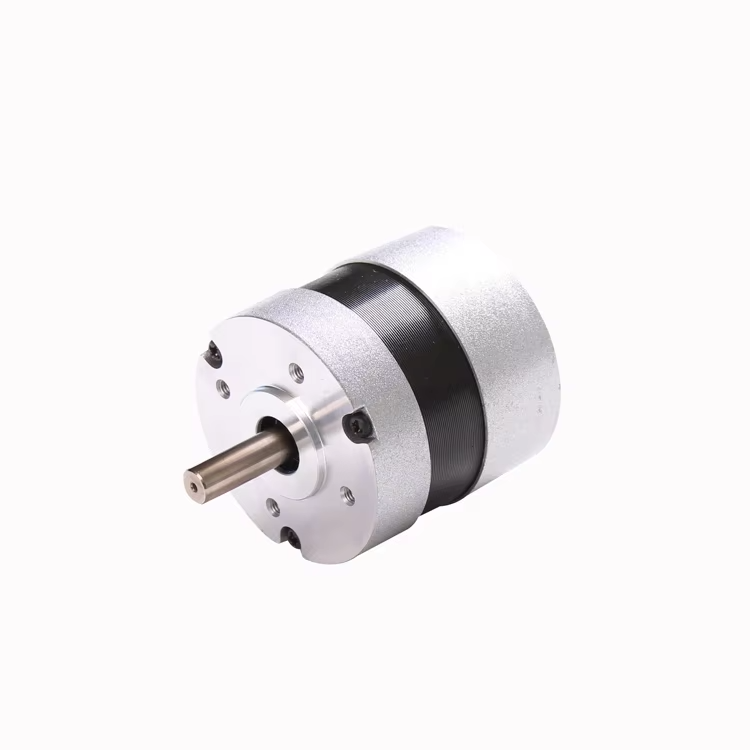
The table below compares the efficiency of a Brushless Motor and a conventional AC induction motor across different load points.
| Load point (% of rated) | Brushless Motor efficiency | AC induction motor efficiency | Efficiency advantage |
| 100% | 92% | 90% | 2 percentage points |
| 75% | 91% | 88% | 3 percentage points |
| 50% | 89% | 84% | 5 percentage points |
| 30% | 85% | 76% | 9 percentage points |
| 15% | 78% | 62% | 16 percentage points |
In a typical application that operates at an average load of 50 percent, the Brushless Motor consumes 5 percentage points less energy than the induction motor. For a 10 kW motor running 4,000 hours per year, this translates to 2,000 kWh saved per year. At $0.12 per kWh, the annual saving is $240 per motor. For a facility with 50 motors, the annual saving is $12,000. Hongyunteng Intelligent Technology (Xiamen) Co., Ltd. designs Brushless Motor units that maintain high efficiency across the load range, as verified by our efficiency mapping tests.
2. Where Do the Losses Occur in a Brushless Motor and How Are They Minimized?
The efficiency of a Brushless Motor is determined by the sum of its losses. There are four main loss categories: copper loss, iron loss, mechanical loss, and driver loss. Copper loss is the resistive heating in the stator windings. It is proportional to the square of the current. Iron loss is the hysteresis and eddy current loss in the stator core. It is proportional to the frequency and the flux density. Mechanical loss is the friction in the bearings and the windage of the rotor. Driver loss is the switching and conduction loss in the power electronics. The table below shows the typical loss breakdown for a 1 kW Brushless Motor at full load.
| Loss category | Typical percentage of input power | Design method to minimize loss |
| Copper loss | 4 – 6% | Use of thicker wire, higher slot fill factor, optimized winding pattern |
| Iron loss | 2 – 4% | Use of high-grade silicon steel, thin laminations, optimized magnetic circuit |
| Mechanical loss | 1 – 2% | Precision bearings, balanced rotor, low-friction seals |
| Driver loss | 1 – 3% | Low RDS(on) MOSFETs, advanced PWM algorithm, synchronous rectification |
| Total loss | 8 – 15% | Overall efficiency 85 – 92% |
Our factory uses a combination of finite element analysis and empirical testing to optimize the magnetic circuit and the winding design. We also use a sinusoidal PWM algorithm that reduces harmonic losses in the driver. The result is a Brushless Motor that achieves 92 percent efficiency at full load and maintains above 85 percent efficiency at 30 percent load.
3. How Does the Efficiency Map Help in Selecting the Right Motor for an Application?
An efficiency map is a contour plot that shows the efficiency of a Brushless Motor across the entire speed-torque operating range. It is a more useful tool than a single nominal efficiency value because it allows the designer to select a motor that matches the actual operating profile of the application. The table below shows a simplified efficiency map for a 1 kW Brushless Motor.
| Speed (% of rated) | Torque 25% | Torque 50% | Torque 75% | Torque 100% |
| 25% | 72% | 78% | 80% | 79% |
| 50% | 80% | 86% | 88% | 87% |
| 75% | 84% | 89% | 91% | 90% |
| 100% | 85% | 90% | 92% | 91% |
The efficiency map shows that the motor achieves its highest efficiency at 75 to 100 percent speed and 50 to 75 percent torque. If the application operates primarily in that region, the motor will deliver excellent energy performance. If the application operates at low speed and low torque, the efficiency will be lower. In our factory, we provide efficiency maps for all of our Brushless Motor models so that customers can verify the performance in their specific operating range.
4. What Is the Total Cost of Ownership Impact of Higher Efficiency?
The purchase price of a Brushless Motor is typically 20 to 40 percent higher than an equivalent AC induction motor. However, the higher efficiency translates to lower energy consumption over the life of the equipment. The table below shows a total cost of ownership comparison for a 5 kW motor running 6,000 hours per year for 10 years.
| Cost component | AC induction motor | Brushless Motor |
| Purchase price | $450 | $600 |
| Average efficiency over load profile | 82% | 89% |
| Annual energy consumption (kWh) | 36,585 | 33,708 |
| Annual energy cost ($0.12/kWh) | $4,390 | $4,045 |
| 10-year energy cost | $43,900 | $40,450 |
| 10-year total cost (purchase + energy) | $44,350 | $41,050 |
| 10-year saving | — | $3,300 per motor |
The higher purchase price of the Brushless Motor is recovered within 3 to 5 years through lower energy costs. Over a 10-year life, the total saving is $3,300 per motor. For a facility with 100 motors, the total saving is $330,000. This is the financial case for high transmission efficiency.
Frequently Asked Questions About Brushless Motor Efficiency
Summary for Design Engineers and Procurement Specialists
High transmission efficiency is a key benefit of the Brushless Motor because it reduces energy consumption across the entire operating range, not just at the rated point. The efficiency advantage is most pronounced at partial loads, which is where most equipment operates. When evaluating a Brushless Motor, ask for the efficiency map, not just the nominal efficiency. The map shows the performance in the actual operating region. The total cost of ownership analysis shows that the higher purchase price is recovered through lower energy costs within a few years. Hongyunteng Intelligent Technology (Xiamen) Co., Ltd. designs Brushless Motor units with high efficiency across the load range and provides full performance data for each model.
Hongyunteng Intelligent Technology (Xiamen) Co., Ltd. manufactures Brushless Motor units from 50 W to 15 kW, with integrated or separate drivers. We provide efficiency maps, loss breakdown data, and total cost of ownership calculations for all of our products.