

Why Can Hub Motors Recover Energy While Geared Motors Cannot?
2026-11-05
1. Why Does Energy Recovery Depend on the Drivetrain Path Rather Than the Motor Alone?
A fleet engineer compares two 48 V delivery vehicles on the same stop and go route. One uses Hub Motors in the rear wheels. The other uses a geared motor and a differential. The first vehicle returns energy to the battery on every downhill section and every braking event. The second vehicle heats its brake drums and sends nothing back. At Ningbo Qianjiang Motor Co., Ltd., our factory tests both drivetrains on our test bench and on a closed test track. The difference is not the motor winding alone. It is the path that torque takes when the wheel pushes back against the drivetrain.
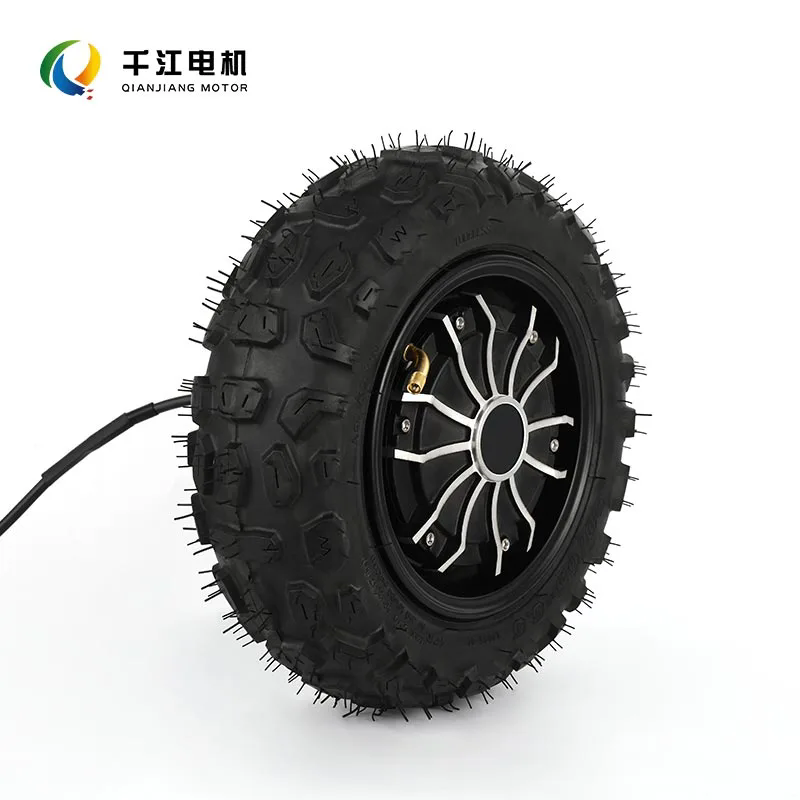
2. What Makes a Direct Drive Wheel Motor Naturally Suited to Regenerative Braking?
Hub Motors sit inside the wheel and drive the rim directly. There is no clutch, no reduction gear, and no differential between the motor and the road. When the wheel slows, the rotor slows with it, and the motor becomes a generator. Our engineering team measures the back EMF on our factory dynamometer at different speeds. The direct path means the regeneration torque is available as soon as the controller commands it. A geared drivetrain adds stages between the wheel and the motor. Each stage has inertia, friction, and backlash. Some stages also have a one way clutch or a self locking worm gear that prevents the wheel from driving the motor backward.
| Drivetrain path | Reverse drive from wheel to motor | Typical recovery result |
| Direct drive wheel motor | Continuous, no clutch | High recovery in stop and go duty |
| Parallel shaft gear reducer | Possible if not self locking | Moderate recovery with added losses |
| Worm gear reducer | Usually self locking | No recovery unless a bypass is fitted |
| One way clutch in the hub | Blocks reverse torque | No recovery by design |
3. Why Do Many Geared Motor Architectures Block Reverse Energy Flow?
Many geared motor architectures are selected for a high reduction ratio in a small package. A worm gear set can hold a load without a brake because the lead angle is below the friction angle. That same property blocks the wheel from turning the motor when the vehicle coasts. A parallel shaft gear set does not have this self locking property, but it still adds two or three meshes of loss. At Ningbo Qianjiang Motor Co., Ltd., our experience with light electric vehicles shows that the controller is often programmed for forward drive only. The brake lever operates a friction brake, and the motor is switched off. In that configuration the gears are not the only blocker. The control strategy is. Hub Motors avoid the self locking geometry because the rotor is the wheel.
| Parameter | Typical light vehicle value | Effect on recovery |
| Rated voltage | 48, 60, or 72 V | Sets the DC link window for charge current |
| Rated power | 350 to 1200 W | Limits continuous regeneration torque |
| Peak power | 700 to 2400 W | Allows short braking torque peaks |
| Rated speed | 300 to 600 rpm | Defines the useful recovery speed range |
| Efficiency | 85 to 92 percent | Direct drive keeps more energy in the battery |
| Protection rating | IP65 | Allows operation in wet and dusty service |
| Braking torque | 15 to 45 Nm | Must blend with the friction brake |
4. How Do Controller and Battery Limits Decide the Actual Recovery?
At Ningbo Qianjiang Motor Co., Ltd., a Hub Motors system can only recover energy if the controller allows current to flow back to the battery. The controller must measure the rotor position, limit the charging current, and protect the DC link from overvoltage. Our factory configures the controller with a braking map that blends electrical torque with the friction brake. Our controller partners provide the charge limit from the battery management system. If the battery is cold or near full charge, the limit drops and the recovery torque must be reduced. The motor can generate, but the energy has nowhere to go. A geared motor with a bidirectional controller can also recover, provided the gear train is not self locking. The difference is that the direct drive layout makes the recovery path shorter and the control problem simpler.
5. How Should Vehicle Designers Specify and Verify Energy Recovery?
Vehicle designers should specify the recovery target in watt hours per kilometer, not just the motor efficiency. They should define the maximum braking torque, the speed range where recovery is active, and the battery charge limit. Our application engineers review the drivetrain layout before the controller is tuned. Our factory provides a recovery map for each Hub Motors model, with the torque and current at each speed. The designer should verify the map on a chassis dynamometer and on a test track. A recovery system that works on the bench may be disabled in the field if the battery management system rejects the charge current.
Direct drive wheel motors recover energy because the wheel and the rotor are the same rotating mass. Geared architectures can recover only when the gear train is reversible and the controller is configured for bidirectional power. The common claim that geared motors cannot recover is too broad. A worm gear that is self locking will block recovery, and a one way clutch will block it by design, but a parallel shaft reducer with a bidirectional controller can recover with added losses. The practical decision is to define the duty cycle, the battery charge limit, and the drivetrain path before selecting the motor. Our customers use this checklist to avoid a recovery system that looks good on paper but never operates in service.
Frequently Asked Questions About Energy Recovery and Drivetrain Choice
Question 1: Do all geared motors really block energy recovery?
Answer: No. A parallel shaft gear reducer can transmit torque in reverse if its efficiency is high and the controller supports regeneration. The block usually comes from a worm gear that is self locking, a one way clutch, or a controller that only drives forward. The drivetrain path and the control strategy decide, not the presence of gears alone.
Question 2: What controller features are required before a wheel motor can recover energy?
Answer: The controller needs bidirectional current control, a braking input or throttle release map, a battery charge limit from the battery management system, and overvoltage protection. Without these, the motor can generate voltage but the energy cannot be safely stored.
Question 3: How much range can energy recovery add in a light electric vehicle?
Answer: In stop and go delivery duty, recovery can add 10 to 20 percent range. On flat constant speed routes, the gain is 2 to 5 percent. The gain depends on speed, deceleration rate, battery state of charge, and temperature.