

What Makes Regenerative Braking a Standard Hub Motor Advantage?
2026-10-19
An electric scooter control engineer is comparing two 48V 400W Hub Motors from different suppliers. Both motors have the same rated torque and the same efficiency at cruising speed. The engineer installs each motor on the same test scooter and runs the same urban route with the same rider. The first motor delivers a range of 68 km. The second motor delivers a range of 80 km. The battery capacity is identical. The difference is the regenerative braking strategy. The second motor's controller recovers energy during deceleration and downhill segments, while the first motor's controller disables regeneration to avoid a slight drag feeling. The 12 km difference is not a battery issue. It is a control strategy issue. This guide explains how regenerative braking works in a hub motor and why it is a standard advantage.
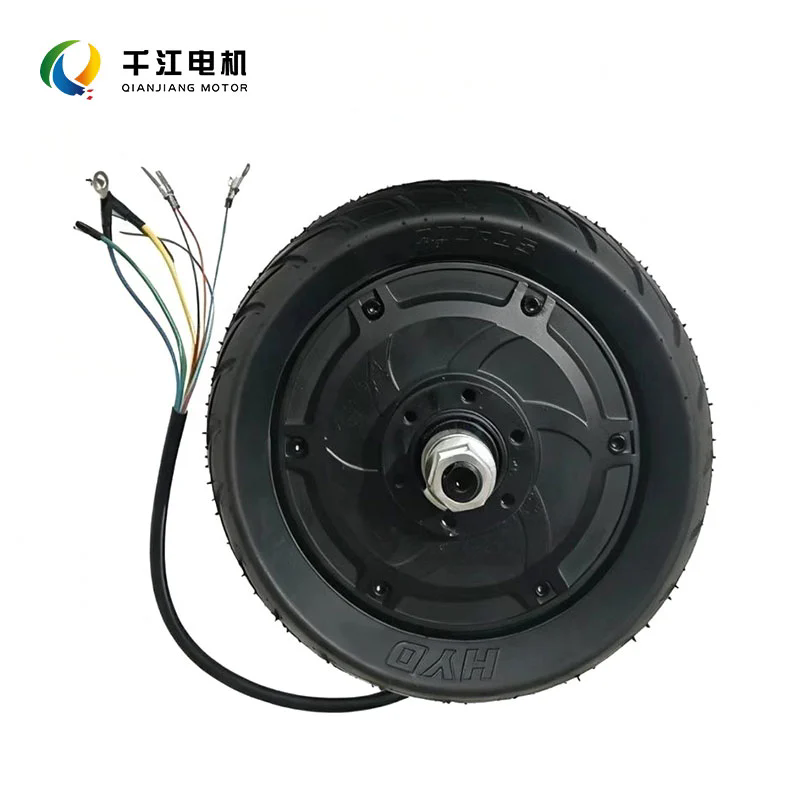
1. How Does a Hub Motor Generate Electricity During Deceleration?
When the rider releases the throttle or applies the brake, the Hub Motors continues to rotate because of the vehicle's momentum. The rotating magnets induce a voltage in the stator windings. This voltage is called the back electromotive force (back-EMF). The magnitude of the back-EMF is proportional to the rotational speed. If the controller allows the current to flow, the motor acts as a generator. The kinetic energy of the vehicle is converted into electrical energy, which is fed back to the battery. The braking force is proportional to the current that the controller allows to flow. The table below shows the back-EMF and braking force at different speeds for a typical 48V hub motor.
| Vehicle speed (km/h) | Motor RPM | Back-EMF (V) | Recoverable power at 10A (W) | Braking force (N) |
| 10 | 85 | 12 | 120 | 43 |
| 20 | 170 | 24 | 240 | 43 |
| 30 | 255 | 36 | 360 | 43 |
| 40 | 340 | 48 | 480 | 43 |
| 50 | 425 | 60 | 600 | 43 |
The back-EMF increases with speed. At low speed, the back-EMF is lower than the battery voltage, so the controller must boost the voltage to charge the battery. At high speed, the back-EMF is higher than the battery voltage, and the controller must buck the voltage. In our factory, we design Hub Motors with a winding configuration that produces a back-EMF of 48V at the nominal cruising speed. This simplifies the controller design and improves the recovery efficiency. Ningbo Qianjiang Motor Co., Ltd. has been manufacturing hub motors for over 15 years.
2. What Determines How Much Energy Is Actually Recovered?
The amount of energy recovered depends on three factors: the recovery strategy, the battery's acceptance rate, and the rider's behavior. The recovery strategy determines when and how strongly the controller applies regenerative braking. A conservative strategy recovers energy only when the brake lever is pressed. An aggressive strategy recovers energy whenever the throttle is released. The battery's acceptance rate determines how much of the recovered energy can be stored. If the battery is cold or nearly full, it may not accept the charge. The rider's behavior determines how often deceleration occurs. A rider who coasts frequently and brakes gently recovers more energy than a rider who brakes hard and late. The table below shows the typical recovery efficiency for different strategies.
| Recovery strategy | Trigger condition | Typical recovery efficiency | Rider feel |
| Brake-only | Brake lever pressed | 8 – 12% | No drag during coasting |
| Throttle-release | Throttle released | 15 – 22% | Noticeable drag |
| Adaptive | Throttle release + speed + battery SOC | 18 – 25% | Moderate drag, optimized |
Control engineer's note: The recovery efficiency is the percentage of the kinetic energy that is returned to the battery. A 20 percent recovery efficiency means that 20 percent of the energy that would have been dissipated as heat in the brakes is instead stored in the battery. For a scooter that consumes 1.2 kWh per 100 km, a 20 percent recovery efficiency can reduce the consumption to 1.0 kWh per 100 km, which is a 17 percent increase in range. In our factory, we have measured the recovery efficiency of our hub motors on a dynamometer and on real urban routes. The adaptive strategy provides the best balance of range and rider comfort.
3. Why Is Regenerative Braking Considered a Standard Advantage of Hub Motors?
Regenerative braking is a standard advantage of Hub Motors because the motor is directly connected to the wheel. There is no transmission, no clutch, and no belt. The motor always rotates with the wheel, so it is always ready to generate electricity when the controller commands it. In a mid-drive motor system, the motor is connected to the pedals through a transmission. Regenerative braking is more complex because the motor must be engaged with the wheel, and the transmission may not allow the motor to drive the wheel during deceleration. The table below compares the regenerative braking capability of hub motors and mid-drive motors.
| Parameter | Hub Motors | Mid-drive motors |
| Direct connection to wheel | Yes | No (through drivetrain) |
| Regenerative braking capability | Standard | Limited or not available |
| Controller complexity | Moderate | High (requires engagement mechanism) |
| Recovery efficiency | 15 – 25% | 0 – 10% |
| Additional cost | None (included in controller) | High (requires special hardware) |
In our factory, we design Hub Motors with the controller integrated into the motor housing or mounted on the frame. The controller includes the regenerative braking function as a standard feature. There is no additional hardware cost. Ningbo Qianjiang Motor Co., Ltd. provides hub motors with programmable recovery strategies that can be tuned for different vehicle models and rider preferences.
4. What Are the Practical Benefits Beyond Range Extension?
Regenerative braking provides benefits beyond range extension. The first is reduced brake wear. The regenerative braking slows the vehicle before the mechanical brakes are applied, which reduces the heat and wear on the brake pads. The second is improved safety on long descents. The regenerative braking provides a consistent braking force that does not fade, unlike mechanical brakes that can overheat. The third is smoother deceleration. The controller can modulate the regenerative braking force to provide a smooth, progressive deceleration. The table below summarizes the practical benefits.
| Benefit | Mechanism | Typical improvement |
| Extended range | Energy recovery to battery | 10 – 20% increase |
| Reduced brake wear | Regenerative braking shares the braking load | 30 – 50% longer pad life |
| No brake fade on descents | Regenerative braking is not friction-based | Consistent braking force |
| Smoother deceleration | Controller modulates current | Progressive feel |
In our factory, we test the brake pad life of our Hub Motors on a test track with and without regenerative braking. The pads last 40 percent longer with regenerative braking enabled. We also test the braking performance on a 10 percent descent. The regenerative braking maintains a constant speed without any brake fade. Ningbo Qianjiang Motor Co., Ltd. provides test reports for all of our hub motors.
Frequently Asked Questions About Regenerative Braking in Hub Motors
Summary for EV Control Engineers and Product Managers
Regenerative braking is a standard advantage of Hub Motors because the motor is directly connected to the wheel and can generate electricity whenever the controller commands it. The back-EMF increases with speed, and the controller manages the recovery to maximize efficiency and protect the battery. The practical benefits include extended range, reduced brake wear, no brake fade on descents, and smoother deceleration. The recovery efficiency depends on the strategy, the battery acceptance rate, and the rider behavior. An adaptive strategy provides the best balance. Ningbo Qianjiang Motor Co., Ltd. has been manufacturing hub motors for over 15 years and provides programmable regenerative braking controllers for our customers.
Ningbo Qianjiang Motor Co., Ltd. manufactures Hub Motors with integrated regenerative braking controllers, programmable recovery strategies, and thermal protection. We provide dynamometer test reports and real-world range data for all of our products.