

What Makes 1000W Electric Bike Motors Suitable for Everyday Riding?
2026-11-20
For electric bike manufacturers, a 1000W motor can offer a practical balance between everyday usability and additional power capacity. It provides more output potential than many entry-level commuter configurations, making it worth considering for vehicles that encounter moderate hills, frequent stops, heavier riders or additional cargo. However, rated power alone does not determine how a bike performs. Torque, rotational speed, voltage, efficiency and controller compatibility all influence acceleration, climbing ability and energy consumption. Choosing the right Electric Bike Motors configuration means matching these specifications to the vehicle's actual riding conditions.
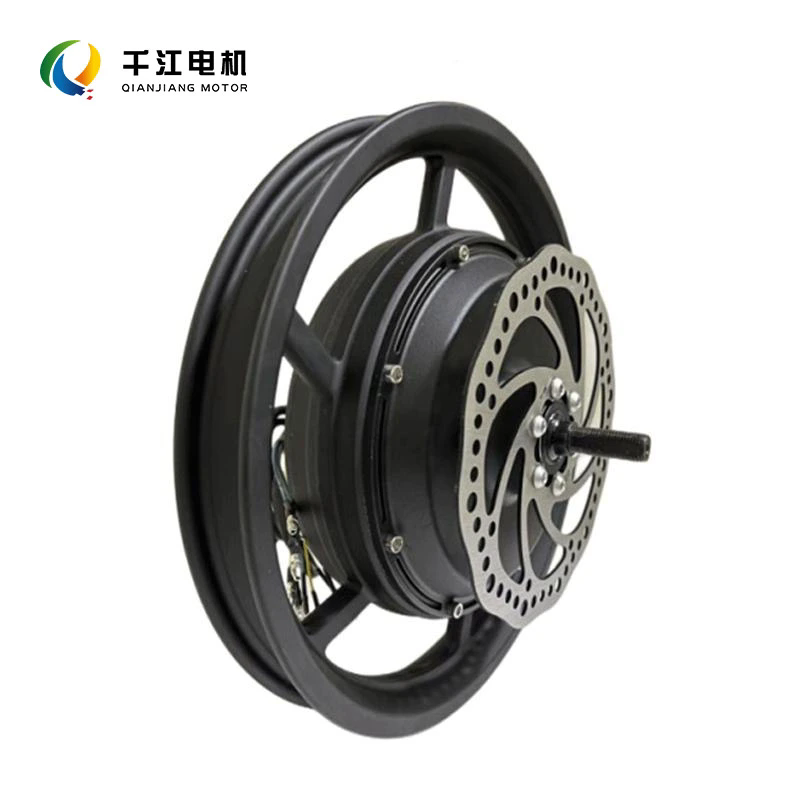
Ningbo Qianjiang Motor Co., Ltd. offers a product range covering 10-inch and 11-inch motor sizes, 48V, 60V and 72V DC voltage options, and rated power from 1000W to 4000W. The published selection guidance identifies 60V and 1000W to 1500W as a reference configuration for urban commuting. This makes the 1000W option a relevant starting point for manufacturers developing everyday-use electric vehicles, provided that the battery, controller, wheel arrangement and local vehicle regulations are properly considered.
Why Can a 1000W Configuration Work Well for Everyday Riding?
Daily riding involves more than maintaining a constant speed on a flat road. Commuters regularly accelerate away from junctions, slow down for traffic, cross uneven surfaces and encounter changes in road gradient. Some vehicles also carry groceries, work equipment or other everyday loads. A motor needs to provide enough torque and power to handle these changing conditions without being unnecessarily oversized for the vehicle.
A 1000W rating provides a useful power category for applications that require more assistance than a basic low-power commuter setup. It can give vehicle designers additional flexibility when balancing acceleration, load requirements and cruising performance. The actual result depends on the motor's torque characteristics, operating speed and controller settings. A 1000W rating should therefore be treated as a rated output specification, not a promise of a particular acceleration time or top speed.
Several everyday situations help explain why this power level is worth evaluating:
- Urban stop-and-go traffic: Frequent starts place repeated demands on the motor. Suitable torque delivery helps the vehicle pull away smoothly when traffic begins moving.
- Moderate gradients: Climbing requires additional mechanical power. A suitable 1000W configuration can provide more operating capacity for routes with regular inclines.
- Carrying everyday loads: A rider carrying a backpack, shopping or work equipment increases the total vehicle load. The motor must provide enough torque to move that additional mass.
- Changing road conditions: Headwinds, rough pavement and different tyre surfaces can increase resistance. A well-matched motor gives the vehicle more flexibility when conditions vary.
- Longer daily journeys: A motor should be selected for the expected duty cycle, not just short acceleration bursts. Thermal performance and continuous operating requirements matter when the vehicle is used regularly.
There is an important difference between having additional power capacity and consuming maximum power throughout a journey. A 1000W motor does not continuously draw 1000W simply because that is its rated power. Actual electrical demand changes with throttle input, vehicle speed, rider weight, road gradient and controller operation. On a level road at a steady speed, the motor may require considerably less power than it does during acceleration or climbing.
The best everyday configuration is therefore not necessarily the one with the highest available output. It is the one that can meet the vehicle's normal performance requirements without operating under excessive electrical or thermal stress. Manufacturers should consider how often the vehicle encounters hills, heavy loads and repeated acceleration before finalising the motor rating.
Which Product Specifications Matter Most When Selecting a 1000W Motor?
Rated power is an important starting point, but buyers should also examine voltage, torque, speed and efficiency. These parameters describe different aspects of motor performance. Voltage affects electrical-system compatibility, torque relates to rotational force, RPM describes rotational speed, and efficiency indicates how effectively electrical input is converted into mechanical output under defined conditions.
The following specifications are published for the Electric Bike Motors product range. They represent the available range or configuration options rather than the guaranteed specifications of every individual 1000W model.
| Technical Parameter | Published Specification | Importance for Everyday Applications |
| Motor size | 10-inch and 11-inch | Provides different installation and vehicle design options. Confirm the exact dimensions and mounting arrangement. |
| Rated voltage | 48V, 60V and 72V DC | Must match the battery and controller electrical system. |
| Rated power | 1000W to 4000W | 1000W is the starting power option in the published range. |
| Rated torque | 30N·m to 70N·m | Relevant to acceleration, climbing and moving a loaded vehicle. Confirm the exact 1000W model value. |
| Rotational speed | 200 to 1500 RPM | Needs to correspond to the wheel arrangement and target vehicle speed. |
| Efficiency | At least 80% | Indicates the stated efficiency level. Request the test conditions and model-specific data. |
| Position sensor | Hall sensor | Provides rotor-position feedback for electronic motor commutation. |
| Stator size | 115 × 90, as listed | Confirm the unit and dimensional drawing before installation. |
| Protection rating | Standard IP56; up to IP67 for high-end customisation | Relevant to dust and water exposure. Confirm the rating for the selected configuration. |
| Brake type | Disc brake or electronic brake | Must be coordinated with the vehicle's braking and electrical control design. |
| Tyre application | Road tyres and off-road tyres | Supports different vehicle uses and surface conditions. |
| Available colours | Black, white, gold and purple | Provides options for product appearance and vehicle design. |
| Certification information | CE and UL listed on the product page | Buyers should verify certificate numbers, model coverage and applicable standards. |
Voltage compatibility should be checked before comparing performance figures. The product range includes 48V, 60V and 72V DC options, but the selected motor must be matched with a battery and controller designed for the same electrical system. A 60V configuration is identified for urban commuting in the published application guidance. Manufacturers should still confirm the operating voltage range, controller limits and battery discharge capability for the exact model.
Torque is particularly relevant to everyday riding because it affects how the vehicle responds when starting from rest and climbing a gradient. A motor with suitable torque can help move the combined mass of the rider and vehicle without requiring the system to operate beyond its intended limits. However, the published 30N·m to 70N·m figure covers the product range. Buyers should not assume that every 1000W model delivers the same torque. The individual model specification is needed for a reliable comparison.
RPM should be considered alongside wheel dimensions and the intended speed range. A motor's rotational speed and the wheel's effective diameter influence the relationship between motor rotation and road speed. Incorrect matching can affect acceleration, cruising characteristics and operating efficiency. Before approving a configuration, the vehicle designer should check the motor drawing, wheel arrangement and target operating conditions together.
The published construction information identifies a stator with silicon-steel laminations, three-phase enamelled windings and Hall position sensors. The rotor uses permanent magnets and sealed bearings, while end caps and sealing rings form part of the sealing structure. Three-phase power connections are identified as U, V and W, together with Hall signal wiring. These details are useful when checking controller compatibility, wiring requirements and mechanical integration.
How Do Motor Efficiency and System Matching Affect Everyday Performance?
Efficiency describes the proportion of electrical input converted into mechanical output at a particular operating point. When a motor delivers the same mechanical output with lower electrical input, less energy is lost through heat and other internal losses. This can help reduce battery demand for a given riding condition. The published efficiency for this product range is at least 80%, but buyers should request the relevant test method and operating point before using this figure in a detailed vehicle energy calculation.
Real-world energy consumption is influenced by more than the motor. Vehicle mass, tyre pressure, road gradient, wind resistance and riding speed all affect the mechanical power required to move the bike. A vehicle travelling uphill with a heavy load will generally need more power than the same vehicle travelling at a steady speed on level ground. Even a highly efficient motor cannot eliminate the energy required to overcome these external loads.
Battery capacity and discharge capability also matter. Battery capacity is commonly expressed in watt-hours and can be estimated by multiplying nominal voltage by amp-hour capacity. For example, a nominal 60V battery rated at 20Ah has a nominal energy capacity of 1200Wh. This is a calculated nominal figure rather than a guarantee of usable energy. Battery management limits, cell condition, temperature and discharge rate all affect the energy available during operation.
The controller is responsible for regulating the electrical power supplied to the motor. It must match the motor's voltage, current requirements and Hall sensor arrangement. A controller with an unsuitable current limit may restrict acceleration or climbing performance. An excessively high current setting can increase electrical and thermal stress on the motor, battery and controller.
For a reliable daily-use system, manufacturers should review the following points:
- Battery and motor voltage: Confirm that the nominal voltage and operating range are compatible.
- Continuous and peak current: Check that the battery and controller can support the motor's actual electrical requirements.
- Hall sensor wiring: Verify the signal sequence and controller compatibility before operation.
- Thermal performance: Evaluate motor and controller temperatures during repeated acceleration and sustained climbing.
- Brake integration: Ensure that the selected disc or electronic brake arrangement works with the vehicle's control system.
- Environmental protection: Confirm the actual IP rating required for the vehicle's expected exposure to rain, dust and road debris.
Energy consumption should ideally be evaluated through repeatable vehicle testing. Recording battery energy use over a defined route provides a practical basis for comparing different configurations. Manufacturers can measure watt-hours consumed and divide the result by distance travelled to obtain Wh/km or Wh/mile. For a fair comparison, the test should use consistent vehicle mass, tyre pressure, route, speed profile and ambient conditions.
Our selection approach considers the intended vehicle, expected load, battery voltage and normal riding conditions together. Our product range includes different power and voltage options, allowing buyers to discuss configurations for different applications. Our engineering team can review the required motor specifications and controller compatibility. Our factory can support project discussions involving product customisation and production requirements. Our technical documentation should be checked against the exact model before a design is approved.
Where Can 1000W Electric Bike Motors Be Used, and What Should Buyers Verify?
The product page identifies several vehicle applications, including two-wheel, three-wheel and four-wheel electric bikes, folding e-bikes, fat-tire e-bikes and go-karts. This broad application range means that the correct motor configuration depends on more than the vehicle's general category. Wheel size, installation space, axle dimensions, vehicle mass, target speed and expected load all affect the selection.
For urban commuting, the published recommendation is 60V with rated power between 1000W and 1500W. This gives manufacturers a reference point when developing a vehicle for everyday road use. A 1000W option may be considered where the vehicle needs additional output capacity, while the final choice should account for the required torque, speed and local regulations.
Different applications require different priorities:
- Folding electric bikes: Check frame clearance, motor dimensions, wheel compatibility and the effect of motor weight on portability.
- Fat-tire electric bikes: Consider tyre diameter, rolling resistance, vehicle mass and the additional torque needed for different surfaces.
- Three-wheel electric bikes: Evaluate the total load, stability, axle arrangement and expected operating duty.
- Four-wheel electric vehicles and go-karts: Confirm that the motor type, mounting structure, cooling conditions and controller are appropriate for the vehicle architecture.
- Mixed-surface vehicles: Check the tyre selection, protection rating and mechanical durability requirements for the intended environment.
Buyers should also distinguish between rated power and peak power. Rated power relates to the motor's specified operating capability under defined conditions, while peak power refers to a higher output that may be available for a limited period. The two figures should not be treated as interchangeable. For everyday applications, continuous operating requirements and thermal performance are especially important because the vehicle may be used repeatedly over long periods.
Environmental protection deserves careful attention. The product page lists standard IP56 protection and IP67 availability for high-end customisation. Buyers should confirm the rating of the exact model and understand the conditions covered by the relevant test. An IP rating does not automatically establish resistance to every form of water exposure, pressure washing or long-term immersion.
Legal classification is another essential consideration. In the United States, the federal definition of a low-speed electric bicycle under 15 U.S.C. Section 2085 specifies a motor of less than 750W and a maximum motor-only speed of less than 20 mph under the statutory conditions. California also defines electric bicycles using a motor that does not exceed 750W. A 1000W vehicle therefore does not fall within these definitions of a low-speed electric bicycle. Manufacturers and distributors should verify the applicable vehicle category, road-use rules, registration and equipment requirements in each target market before selling or marketing the vehicle as a street-legal e-bike.
Before requesting a quotation, buyers should prepare the vehicle application, target voltage, required power, wheel size, torque requirements, speed range, brake arrangement and operating environment. Our team can use these details to clarify the available configuration and identify the model-specific documents that need to be reviewed. Our priority is to help buyers establish a technically suitable specification rather than select a motor based on wattage alone.
Conclusion: Is 1000W the Right Power Level for Everyday Riding?
A 1000W motor can be suitable for everyday riding when the vehicle needs additional acceleration, moderate hill-climbing support or the ability to carry heavier loads. The product range provides a 1000W starting option and identifies 60V with 1000W to 1500W as a reference for urban commuting. The final decision should still be based on torque, RPM, efficiency, battery capability, controller compatibility, vehicle design and local regulations.
Ningbo Qianjiang Motor Co., Ltd. provides a range of motor configurations covering different voltage, power, size and protection requirements. Contact our team with your vehicle design, battery specifications and intended application to confirm the exact 1000W model data, discuss compatible components and identify a suitable solution for your production project.
Frequently Asked Questions
Is a 1000W motor suitable for a daily electric bike commute?
A 1000W motor can be considered for daily commuting when the vehicle needs additional acceleration, moderate hill-climbing ability or support for a heavier load. The product selection guidance identifies 60V and 1000W to 1500W as a reference for urban commuting. However, the right configuration depends on the vehicle's weight, route, battery and controller. Buyers must also check local regulations because a 1000W vehicle does not meet the US federal definition of a low-speed electric bicycle.
Does a 1000W motor always consume more battery energy than a lower-powered motor?
No. Rated power indicates the motor's output category, not its constant electrical consumption. Actual battery use depends on the mechanical power required by the vehicle, motor efficiency, controller settings, speed, rider weight, road gradient and riding style. A 1000W motor may consume more energy when its additional output is regularly used, but it does not necessarily draw more power when delivering the same mechanical output as a smaller motor under comparable conditions.
What should buyers confirm before ordering a 1000W motor for an electric bike project?
Buyers should confirm the exact model's rated voltage, continuous and peak power, rated torque, RPM, efficiency test conditions, dimensions, wiring arrangement, Hall sensor compatibility and protection rating. Battery discharge capability, controller current limits, wheel size, brake configuration and mounting dimensions should also be checked. For commercial vehicle projects, request the relevant technical data sheet, drawings and certification documents, then validate the complete motor and vehicle system under the intended operating conditions.