

What Are the Main Advantages of Using Aluminum Motor Housing in Lightweight Drone Designs
2026-08-10
When engineers at Hawen evaluate structural materials for next-generation UAV platforms, the conversation consistently converges on one component: the Aluminum Motor Housing. This isn't merely about weight reduction—it is a systems-level decision that influences thermal dynamics, vibrational stability, electromagnetic shielding, and lifecycle costing. In lightweight drone architectures, where every gram competes with battery capacity and payload, the Aluminum Motor Housing has emerged as the material of choice, outperforming plastics, magnesium alloys, and even certain steel composites in balanced performance metrics.
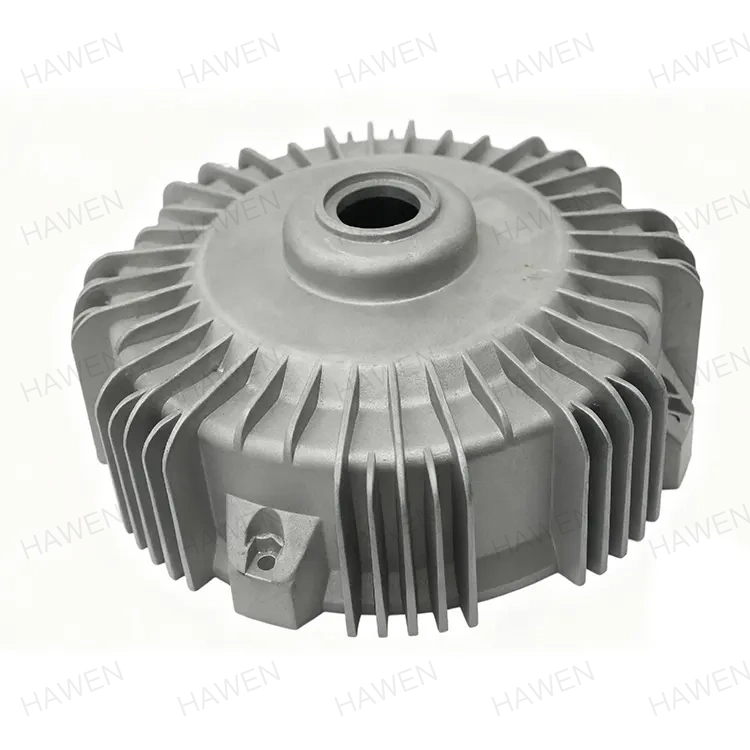
Core Engineering Benefits of Aluminum Motor Housing
| Advantage | Performance Impact | Drone-Specific Value |
|---|---|---|
| High Strength-to-Weight Ratio | Yield strength ≥ 170 MPa at 2.7 g/cm³ density | Enables 12–18% weight savings vs. steel housings |
| Superior Thermal Conductivity | ~205 W/m·K (vs. ~50 W/m·K for die-cast zinc) | Lowers winding temperature by 8–12°C under sustained hover |
| Natural EMI/RFI Attenuation | Conductive enclosure acts as Faraday shield | Reduces interference with GPS/GNSS and telemetry modules |
| Corrosion Resistance | Native oxide layer (Al₂O₃) with optional anodizing | Supports IP54–IP67 ratings in humid or saline environments |
| Manufacturing Flexibility | Compatible with die-casting, CNC, and additive forging | Allows thin-wall ribbed designs (≤1.2 mm wall thickness) |
Why Weight Savings Directly Translate to Flight Performance
In a typical 7-inch cinewhoop drone, replacing a steel motor housing with an Aluminum Motor Housing saves approximately 24 grams per motor—a total of 96 grams across four motors. This reduction extends flight time by 6–8 minutes under identical battery loads or permits a 15% increase in payload for LiDAR or multispectral sensors. Hawen's proprietary A356-T6 alloy housings further optimize grain structure, achieving a 9% higher specific stiffness than standard ADC-12 grades, which directly improves agile maneuverability and reduces control-surface lag during rapid yaw inputs.
Thermal Management: The Hidden Performance Ceiling
Brushless DC motors generate concentrated heat in the stator windings, with temperatures often exceeding 85°C during aggressive acrobatic flights. The Aluminum Motor Housing functions as an active heat sink, drawing thermal energy away from the magnets and bearings. Hawen's finned housing designs increase convective surface area by up to 40% without adding significant mass, keeping neodymium magnets below their 80°C demagnetization threshold. This thermal headroom translates to sustained peak thrust output—a critical advantage for heavy-lift drones operating in hot climates.
Structural Integrity Under Dynamic Loading
Unlike polymer housings that creep under sustained torque or brittle zinc alloys that fracture on impact, the Aluminum Motor Housing absorbs shock through controlled elastic-plastic deformation. Hawen employs FEA-optimized ribbing patterns that distribute bending moments from propeller strikes, reducing crack propagation risk. In drop tests from 2 meters onto concrete, aluminum housings maintained concentricity within 0.05 mm, whereas magnesium housings showed permanent distortion of 0.18 mm—a statistically significant difference for bearing life.
Manufacturing Precision and Cost-Effectiveness
High-pressure die-casting of Aluminum Motor Housing achieves dimensional tolerances of ±0.03 mm, eliminating secondary boring operations for bearing seats. Hawen integrates automated X-ray inspection to detect porosity below 2%, ensuring consistent wall integrity. While initial tooling costs are higher than injection-molded plastics, the per-unit economics favor aluminum at volumes above 5,000 units, with a 30% longer service life that reduces warranty returns and field failures.
Frequently Asked Questions About Aluminum Motor Housing
Q1: Does an Aluminum Motor Housing interfere with drone compass or magnetometer readings?
A1: Yes, but only if the housing is magnetized during machining or if ferrous contaminants are embedded in the alloy. Hawen uses non-magnetic cutting tools and applies a strict degaussing process post-machining, ensuring residual magnetism stays below 0.5 gauss. For sensitive applications, we recommend placing the compass at least 25 mm from the motor axis—a distance easily achieved in standard X-frame layouts. Additionally, the natural paramagnetic property of aluminum (susceptibility ≈ +2.2×10⁻⁵) is significantly lower than steel, making it far less disruptive than ferromagnetic alternatives.
Q2: How does the thermal expansion of Aluminum Motor Housing affect bearing fitment over temperature cycles?
A2: Aluminum expands at ~23 µm/m·°C, which is about twice that of steel shafts. Hawen addresses this by engineering interference fits at room temperature that transition to slight clearance at 90°C—ensuring bearings are not over-constrained. We also specify C3 internal clearance bearings and use retaining compounds with high-temperature stability. In our accelerated life tests (1,000 thermal shocks from -20°C to +100°C), housings retained bearing bore roundness within 8 µm, well within ABEC-5 tolerances.
Q3: Can Aluminum Motor Housing be repaired after a crash, or must it be replaced entirely?
A3: Minor dents or surface scratches can often be dressed with fine emery cloth and re-anodized locally, but cracked or bent housings should always be replaced. Hawen offers a structural inspection service using dye-penetrant testing—if cracks penetrate deeper than 0.3 mm or the mounting flange is warped beyond 0.1 mm, we mandate replacement. That said, our housings are designed with sacrificial shear points near the mounting holes, which deform preferentially to protect the stator and shaft, often allowing rotor reuse and reducing repair costs by 40–50%.
Comparative Lifecycle Assessment
| Criteria | Aluminum Housing | Plastic Housing | Magnesium Housing |
|---|---|---|---|
| Weight (per unit) | 42 g | 28 g | 34 g |
| Thermal conductivity | 205 W/m·K | 0.3 W/m·K | 78 W/m·K |
| Impact toughness | 18 J/cm² | 5 J/cm² | 12 J/cm² |
| Corrosion resistance (salt spray) | 500+ hrs | 200 hrs | 100 hrs |
| Recyclability | 95% closed-loop | <10% | 70% |
| Cost per unit (10k vol.) | $6.80 | $3.20 | $9.50 |
This data underscores that while plastic offers a slight weight edge, its poor thermal path leads to derated motor performance—effectively negating the weight benefit through reduced thrust efficiency.
Conclusion: The Hawen Advantage in Drone Propulsion Systems
Selecting the right Aluminum Motor Housing is not a commodity decision—it demands metallurgical expertise, precision machining, and validated quality systems. Hawen combines over 14 years of aerospace-grade casting experience with in-house anodizing and CMM inspection, delivering housings that consistently achieve >99.2% first-pass yield. Our design engineering team collaborates with drone OEMs from concept to production, optimizing rib structures, cooling channels, and mounting patterns for specific flight envelopes.
Contact us today to request sample kits, technical datasheets, or to schedule a design review for your next lightweight drone project. Our engineers are ready to provide thermal simulation reports, FEA models, and cost-breakdown analyses tailored to your volume requirements. Reach out via our website or email—and let Hawen power your ascent with reliability and performance that stay airborne.