

Induction Motor vs. Synchronous Motor: How Do Their Operating Principles Differ?
2026-10-27
A plant engineer is selecting the drive for a large reciprocating compressor. The compressor runs at a constant speed and requires a high starting torque. The engineer compares an Induction Motor with a synchronous motor. Both are rated for the same power and voltage. The induction motor is less expensive and simpler to install. The synchronous motor is more expensive and requires an excitation system, but it can improve the plant power factor and hold speed exactly under load changes. The choice depends on how the two machines produce torque and how they behave under varying load. This guide explains the operating principles that separate them and how those principles translate into application decisions.
1. Why Does an Induction Motor Need Slip to Produce Torque?
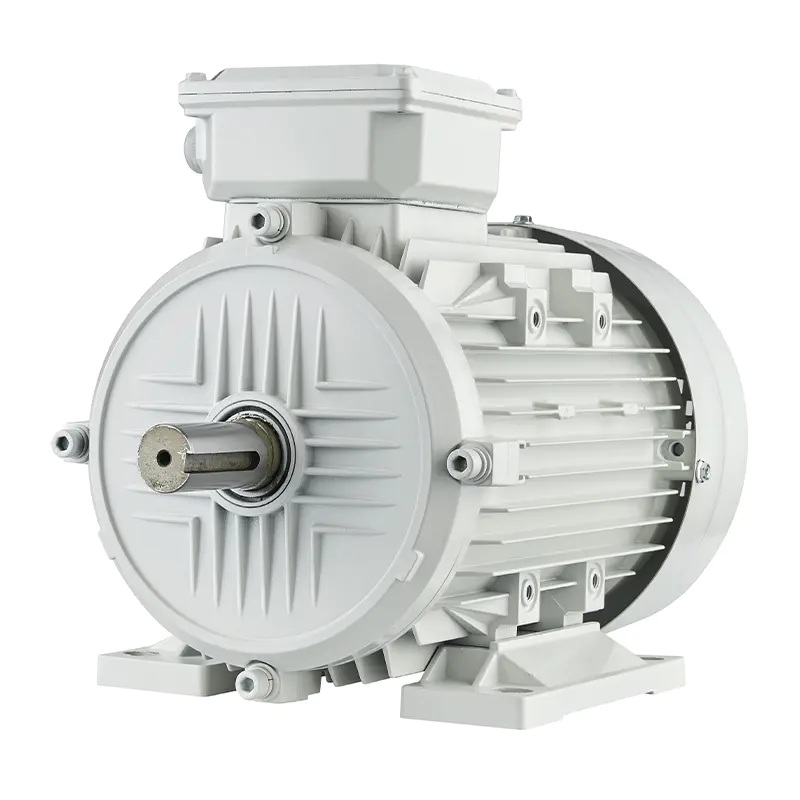
The Induction Motor produces torque by electromagnetic induction. The stator winding is connected to the AC supply and creates a rotating magnetic field. The field cuts the rotor conductors, which are short-circuited in a squirrel cage or connected through slip rings in a wound rotor. The induced current in the rotor interacts with the stator field and produces torque. The rotor cannot turn at exactly the same speed as the field, because if it did, there would be no relative motion, no induced current, and no torque. The difference between the field speed and the rotor speed is called slip. Slip is typically 1 to 5 percent at full load. This is the fundamental operating principle of the induction motor, and it explains why the speed drops slightly as the load increases. In our factory, we manufacture Induction Motor units for industrial drives. Suzhou Zishengya Hardware Electrical Machinery Co., Ltd. has been manufacturing motors for over 12 years.
The slip also means that the induction motor cannot be used for precise speed synchronization. If two induction motors are connected to the same supply and coupled to the same load, they will run at slightly different speeds because of their different slip characteristics. For applications that require exact synchronization, a different principle is needed.
2. How Does a Synchronous Motor Lock to the Supply Frequency Without Slip?
A synchronous motor has a rotor that is excited by a direct current, either through slip rings or through permanent magnets. The rotor creates a fixed magnetic field. The stator creates a rotating field at the synchronous speed, which is determined by the supply frequency and the number of poles. The rotor field locks with the stator field and turns at exactly the same speed. There is no slip at steady state. The torque is produced by the interaction of the two fields, and the rotor angle adjusts to the load. As the load increases, the rotor angle increases, but the speed remains constant. This is the fundamental operating principle of the synchronous motor. The table below compares the speed behavior of the two motor types.
| Operating condition | Induction Motor | Synchronous motor |
| No load speed | Very close to synchronous speed (slip near zero) | Exactly synchronous speed |
| Full load speed | 1 – 5% below synchronous speed | Exactly synchronous speed |
| Speed change with load | Slight drop | No change |
| Starting torque | Moderate (squirrel cage) | Requires damper winding or VFD |
| Power factor control | Lagging, cannot be adjusted | Can be adjusted by field excitation |
In our factory, we manufacture both induction motors and synchronous motors. The selection depends on the load characteristic and the plant power factor requirement. Suzhou Zishengya Hardware Electrical Machinery Co., Ltd. provides application support for both types.
3. What Happens to Starting and Running Behavior When the Rotor Design Changes?
The rotor design determines the starting torque, the starting current, and the running efficiency. An induction motor with a squirrel cage rotor has a simple, rugged construction, but the starting current is five to eight times the rated current. A wound rotor induction motor allows external resistance to be connected during starting, which increases the starting torque and reduces the starting current, but it requires slip rings and maintenance. A synchronous motor cannot start on its own with a DC-excited rotor. It requires a damper winding, which acts like a squirrel cage during starting, or a variable frequency drive that ramps the speed from zero. The table below shows the starting and running characteristics of the three configurations.
| Motor configuration | Starting current | Starting torque | Running efficiency | Maintenance |
| Squirrel cage induction | 5 – 8 times rated | 1.5 – 2.5 times rated | High (IE3/IE4) | Low |
| Wound rotor induction | 2 – 3 times rated (with external resistance) | 2.5 – 3.5 times rated | Moderate | Moderate (slip rings) |
| Synchronous with damper winding | 4 – 6 times rated | 1.5 – 2.0 times rated | Very high | Moderate (excitation system) |
| Synchronous with VFD | 1 – 1.5 times rated | Rated torque from zero speed | Very high | Moderate (excitation and VFD) |
Application engineer's note: The rotor design is not a detail. It determines whether the motor can start the load and whether the plant needs a soft starter or a VFD. In our factory, we review the load torque curve and the starting duty before recommending a motor configuration. Suzhou Zishengya Hardware Electrical Machinery Co., Ltd. provides the starting characteristic curves for each motor model.
4. Why Does the Synchronous Motor Offer Power Factor Correction That the Induction Motor Cannot?
The synchronous motor has a unique capability: the rotor field excitation can be adjusted to change the power factor. When the field is over-excited, the motor draws leading current from the supply. When the field is under-excited, it draws lagging current. This allows the synchronous motor to be used as a synchronous condenser to correct the power factor of the plant, in addition to driving the load. The induction motor cannot do this because its rotor current is induced by the stator, and the power factor is determined by the load and the slip. The table below shows the power factor range and the reactive power capability of the two motor types.
| Parameter | Induction Motor | Synchronous motor (over-excited) |
| Power factor at full load | 0.85 – 0.92 lagging | 0.95 leading to 0.95 lagging (adjustable) |
| Reactive power output | None (absorbs reactive power) | Can supply reactive power to the plant |
| Power factor correction | Requires external capacitor bank | Built-in through field excitation |
| Typical application | General industrial drives | Large compressors, mills, power factor correction |
In our factory, we supply synchronous motors with excitation systems that can be adjusted from the control panel. The excitation system includes an automatic voltage regulator that maintains the power factor at the setpoint. Suzhou Zishengya Hardware Electrical Machinery Co., Ltd. also provides the reactive power calculation for the plant.
5. How Should Engineers Specify and Verify the Right Motor Type for a Given Load?
The specification should start with the load torque curve. The engineer should determine the starting torque, the pull-up torque, the breakdown torque, and the running torque. The engineer should also determine the speed requirement. If the load requires exact speed regardless of load, the synchronous motor is the correct choice. If the load can tolerate a 1 to 5 percent speed drop, the induction motor is simpler and less expensive. The engineer should then consider the starting current limit and the power factor requirement. The verification should include a factory test of the no-load current, the locked rotor current, the efficiency, and the power factor. In our factory, we perform these tests on every motor before shipment and provide the test report with the nameplate data. Suzhou Zishengya Hardware Electrical Machinery Co., Ltd. also provides the motor selection calculation for the specific load.
We recommend that the engineer verify the motor performance at the actual load, not only at the rated load. A motor that is oversized for the load will run at a low power factor and low efficiency. A motor that is undersized will overheat and fail prematurely. Our application engineers can review the load profile and recommend the optimal motor rating.
Frequently Asked Questions About Induction Motors and Synchronous Motors
Summary for Motor Application Engineers
The Induction Motor produces torque by electromagnetic induction and requires slip to operate. The synchronous motor locks to the supply frequency without slip and uses a DC-excited or permanent magnet rotor. The induction motor is simpler, less expensive, and rugged, but its speed drops slightly with load and its power factor cannot be adjusted. The synchronous motor holds speed exactly and can correct the plant power factor, but it requires an excitation system and a starting method. The choice depends on the load torque curve, the speed requirement, the starting current limit, and the power factor requirement. Suzhou Zishengya Hardware Electrical Machinery Co., Ltd. has been manufacturing motors for over 12 years and provides full application support for both types.