

How Does Tire Size Affect the Performance of Electric Bike Motors?
2026-11-24
Tire size has a direct influence on how Electric Bike Motors perform because it changes the relationship between motor torque, wheel speed, ground contact and rolling resistance. A larger overall tire diameter generally increases the distance travelled with each wheel revolution, but it also requires more torque to produce the same tractive force at the road. A wider tire can improve grip and stability in suitable conditions, although additional rolling resistance and weight may affect energy consumption. Choosing the right tire is therefore part of matching the motor to the complete electric bike rather than simply selecting a tyre that fits the frame.
For vehicle manufacturers and component buyers, the important factors include tyre outside diameter, width, tread pattern, inflation pressure, wheel load and the motor's operating characteristics. Ningbo Qianjiang Motor Co., Ltd. provides motor configurations with 48V, 60V and 72V DC options, rated power from 1000W to 4000W, and rated torque from 30 to 70 N·m across its product range. These specifications provide a starting point for evaluating the drive system, but the final result also depends on the tyre and wheel combination fitted to the vehicle.
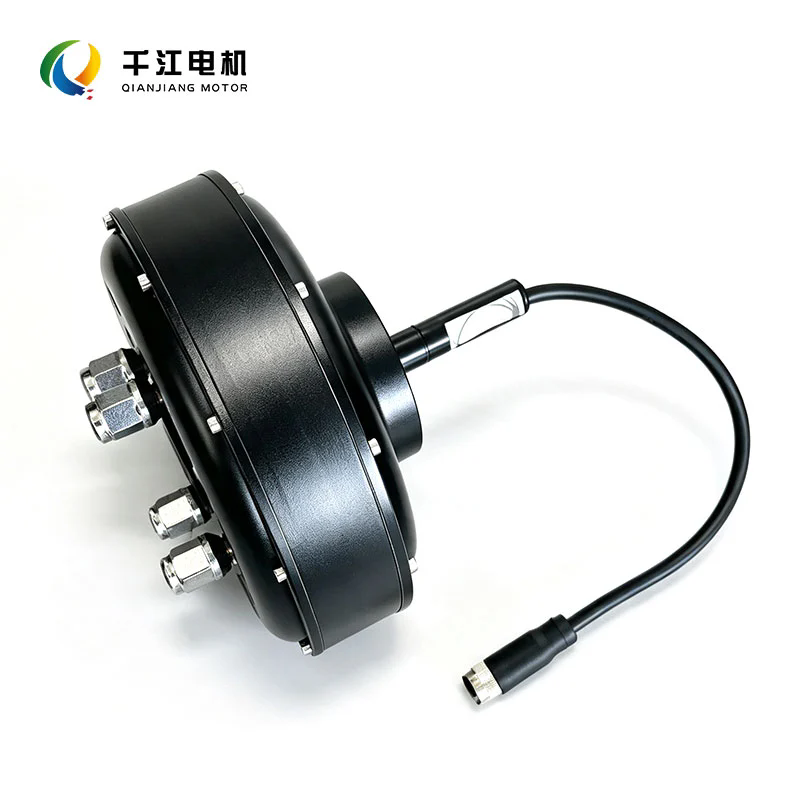
How Does Tire Diameter Change Motor Torque and Wheel Speed?
The outside diameter of a tire determines how far the vehicle travels during one complete wheel revolution. When the motor drives the wheel directly, a larger rolling circumference means that the bike covers more ground at the same wheel RPM. This can increase theoretical road speed, but it also changes the amount of force available at the tyre contact patch for a given wheel torque.
The relationship can be understood through a simple mechanical principle. Tractive force at the ground is approximately equal to wheel torque divided by the effective rolling radius. If wheel torque remains constant, increasing the rolling radius reduces the force available at the contact patch. A smaller rolling radius produces more tractive force from the same wheel torque, although the wheel must rotate faster to maintain the same road speed.
For example, consider two otherwise identical electric bikes using different overall tyre diameters. If both motors operate at the same wheel speed, the bike with the larger tyre travels farther during each revolution. However, when climbing a steep gradient, the larger tyre creates a greater effective lever arm between the axle and the road. The motor must provide more wheel torque to generate the same forward force. This is why a larger tyre can affect hill-start performance even when the motor's rated power has not changed.
The basic relationships are:
- Rolling circumference determines the distance travelled per wheel revolution.
- Effective rolling radius influences the tractive force produced by a given wheel torque.
- Wheel RPM and rolling circumference together determine theoretical road speed.
- Actual speed also depends on motor speed limits, controller settings, vehicle load, aerodynamic drag and road conditions.
For a direct-drive hub motor, tyre diameter has a particularly clear relationship with wheel speed because the motor rotor and wheel rotate together. A larger tyre can raise road speed at a given motor RPM, but it also reduces the force at the contact patch for a given axle torque. The motor may therefore need to work harder during acceleration or climbing. For a geared drive system, the final result also depends on the transmission ratio between the motor and the wheel.
It is important not to confuse motor dimensions with tyre dimensions. The available Qianjiang product information includes 10-inch and 11-inch motor size options. These are product configuration references and should not automatically be interpreted as approved tyre outside diameters or rim sizes. Before selecting a tyre, buyers should confirm the actual wheel interface, rim specification, tyre compatibility and installation dimensions for the chosen model.
Our product selection should consider the intended wheel diameter alongside rated torque and operating speed. A motor with a suitable torque rating for a smaller wheel may require a different configuration when used with a larger rolling radius. Ningbo Qianjiang Motor Co., Ltd. offers product-family rated torque options from 30 to 70 N·m and rotational speed options from 200 to 1500 RPM. These are ranges across the product family, not values that should be assumed to apply together to every model.
When comparing wheel configurations, engineers should use the actual loaded rolling radius rather than relying only on the nominal tyre size printed on its sidewall. Tyre pressure, tread design, vehicle weight and construction can affect the effective rolling circumference. A small difference may be acceptable in one application, while a substantial change can alter acceleration, speed calibration and motor loading. The correct approach is to assess the complete wheel and drive arrangement before finalising the specification.
Why Do Tire Width and Tread Pattern Affect Energy Consumption?
Tyre width influences the contact patch, casing deformation, grip and rolling behaviour. A wider tyre is not automatically less efficient, nor does a narrower tyre always provide better range. The result depends on tyre construction, compound, inflation pressure, tread pattern, road surface and the load carried by the wheel. For electric bike manufacturers, these factors matter because the motor must supply the energy required to overcome rolling resistance throughout the journey.
Rolling resistance is the energy lost as the tyre deforms and recovers while moving over the road. Part of the energy is dissipated as heat within the tyre material. A tyre with a flexible casing, aggressive tread or unsuitable pressure may require more energy to maintain the same speed. The motor must compensate by delivering additional mechanical power, which can increase battery consumption and reduce the distance available from a charge.
Tyre width can influence this behaviour in several ways:
- A wider tyre may provide a larger contact area and improved stability, depending on pressure and construction.
- A wider or heavier tyre can increase rotating mass, affecting acceleration response.
- A tyre with a more aggressive tread may provide better grip on loose surfaces but create additional energy losses on smooth pavement.
- A narrow road-oriented tyre may reduce some rolling losses, provided its load rating, pressure and grip remain suitable.
- An unsuitable pressure can increase casing deformation, heat generation and the risk of damage.
The contact patch is not determined by width alone. It is also influenced by wheel load, tyre pressure and casing stiffness. A heavier rider or cargo load changes how the tyre deforms. If the pressure is too low for the actual load, the casing may flex excessively and generate more heat. If pressure is too high, comfort and grip can be reduced, especially on uneven surfaces. The recommended pressure should therefore follow the tyre manufacturer's load and operating guidance.
Tread pattern should match the surface on which the vehicle is expected to operate. Smooth or lightly patterned tyres are commonly selected for paved roads, where low rolling resistance and predictable handling are priorities. More pronounced tread blocks can improve traction on gravel, dirt or other loose surfaces. However, aggressive tread may create more vibration and rolling resistance when used mainly on smooth roads.
For a commuter electric bike, the priority may be efficient rolling, stable cornering and predictable wet-road behaviour. An off-road vehicle may need a more open tread pattern and a wider contact area to maintain traction on loose ground. A cargo bike may require a tyre with an appropriate load rating and casing strength. In each case, the tyre should be chosen for the vehicle's real duty rather than for appearance alone.
Tyre mass also affects acceleration. A heavier tyre and wheel assembly requires more energy to increase rotational speed. This is related to rotational inertia, which depends on how the mass is distributed around the wheel. Mass located farther from the axle has a greater influence on the energy required to accelerate the wheel than the same mass located close to the hub. This effect is particularly noticeable during repeated stop-start riding.
Our engineering evaluation should therefore consider tyre width, casing construction, tread and operating pressure together. A wider tyre may be appropriate where grip and comfort are important, but the motor and battery must be able to support the additional rolling and acceleration demands. For a road-focused model, a lower-resistance tyre may help improve efficiency, provided the selected tyre still meets the vehicle's handling and load requirements.
Efficiency figures also need to be interpreted carefully. The available product-family information specifies motor efficiency of at least 80 percent. This is a stated motor specification, not a guarantee of whole-vehicle efficiency under every tyre configuration. Tyre losses, controller efficiency, battery condition, bearing friction, vehicle mass and riding speed all influence the energy measured at the battery. A complete vehicle test is needed to compare the actual range of different tyre setups.
How Should Tire Size Be Matched With Motor Voltage, Power and Torque?
Tyre selection should be treated as part of the electrical and mechanical system design. A motor's rated power, voltage and torque establish important operating limits, while tyre diameter determines how those characteristics translate into road speed and tractive force. If the tyre is changed without checking the motor configuration, the vehicle may accelerate differently, climb less effectively or operate outside the intended speed range.
The available product-family specifications can be used as a starting point for matching the drive system:
| Product parameter | Available specification | Relevance to tire selection |
| Motor size options | 10-inch and 11-inch | Confirm the actual wheel interface and approved tyre fitment |
| Rated voltage | 48V, 60V and 72V DC | Must match the battery and controller configuration |
| Rated power | 1000W to 4000W | Helps assess sustained output requirements for the intended wheel and vehicle load |
| Rated torque | 30 to 70 N·m | Relevant to acceleration and tractive force at the tyre contact patch |
| Rotational speed | 200 to 1500 RPM | Works with rolling circumference to determine theoretical road speed |
| Motor efficiency | At least 80 percent as supplied | Should be assessed alongside tyre and whole-vehicle losses |
| Ingress protection | IP56 standard, IP67 high-end custom option | Confirm the exact motor configuration for the intended riding environment |
| Position sensing | Hall sensors | Check controller compatibility and speed or position signal requirements |
Rated power and rated torque describe different aspects of motor performance. Torque is the rotational force available at the motor or wheel, while power describes the rate at which mechanical work is performed. The relationship between power, torque and rotational speed means that a motor's torque output can change across its speed range. Buyers should therefore review the model-specific torque-speed curve instead of assuming that maximum torque is available at maximum RPM.
Voltage selection also needs to match the controller and battery. A 48V, 60V or 72V configuration should be treated as a specific electrical system, not as an interchangeable label. The controller's permitted voltage range, current limit and battery discharge capability determine how much electrical input is available. A larger tyre cannot create additional motor power; it changes the mechanical demand placed on the drive system.
For example, fitting a larger tyre to a motor that already operates near its continuous torque or thermal limit can increase the demand during low-speed acceleration and climbing. The controller may draw more current to meet the requested torque, if its limits and control strategy allow it. Higher current can increase winding and controller heat. If the system reaches its protective limit, output may be reduced to protect components.
A smaller tyre can produce more tractive force from the same wheel torque because its effective radius is shorter. However, it also changes road speed at a given wheel RPM and may increase the motor RPM required to maintain a target speed. The final choice is a compromise between acceleration, climbing, cruising speed, efficiency and mechanical fitment.
Our selection process should include the following checks before approving a tyre and motor combination:
- Confirm the tyre's actual outside diameter and loaded rolling circumference.
- Verify the rim diameter, rim width and tyre manufacturer's fitment guidance.
- Check the motor's rated torque and speed range for the selected configuration.
- Estimate the required tractive force using vehicle mass and expected gradients.
- Confirm that the controller and battery can support the required current.
- Check frame, fork, mudguard and brake clearance throughout wheel rotation.
- Review tyre load rating, inflation pressure and intended road surface.
Vehicle clearance is sometimes overlooked during motor upgrades. A tyre with a larger outside diameter may contact the frame, fork, mudguard or battery enclosure, particularly when the suspension compresses or the wheel moves under load. A wider tyre can also interfere with chainstays, brake components or other nearby parts. Mechanical clearance should be checked on the assembled vehicle, not estimated from nominal tyre dimensions alone.
Ningbo Qianjiang Motor Co., Ltd. provides different motor configurations for electric vehicle applications. For an accurate selection, our team should review the intended tyre dimensions together with vehicle mass, target speed, gradient and daily operating conditions. This helps determine whether the existing motor configuration is suitable or whether a different torque, speed or power option should be considered.
What Should Manufacturers Test Before Changing an Electric Bike Tire?
A tyre change can affect more than road feel. It may influence speed readings, controller calibration, acceleration, braking distance and energy consumption. Manufacturers should therefore validate the complete vehicle after changing tyre diameter, width or construction. A component that physically fits the wheel does not automatically provide the best performance for the motor or vehicle.
A structured validation programme can begin with a comparison of the original and proposed tyre specifications. Record the nominal size, measured outside diameter, loaded circumference, width, mass, tread pattern, pressure range and load rating. Where possible, use the same vehicle, battery condition and test route for both configurations. This helps reduce unrelated variables during the comparison.
Several tests are particularly useful:
- Acceleration test: Compare the time required to reach selected speeds under consistent load and battery conditions.
- Hill-climb test: Evaluate starting ability and sustained climbing performance on a defined gradient.
- Range test: Measure energy consumption over the same route, speed profile and payload.
- Temperature test: Monitor motor and controller temperatures during repeated acceleration and sustained loading.
- Handling test: Assess cornering stability, braking response and grip on the intended road surface.
- Clearance inspection: Check the tyre against the frame, fork, mudguard, brake and other nearby components.
Speedometer accuracy deserves particular attention. If the speed sensor measures wheel rotation, changing the rolling circumference can make the displayed speed inaccurate unless the system is recalibrated. A larger circumference means the vehicle travels farther per revolution. If the display continues using the original circumference value, the indicated speed and recorded distance may no longer match actual road measurements.
Braking performance should also be checked. A change in tyre diameter can alter the relationship between wheel torque and force at the road. Tyre compound, tread and contact conditions affect available grip, while vehicle geometry and brake setup influence stopping behaviour. A tyre with a larger diameter may also change clearance and handling characteristics. Any significant wheel or tyre change should therefore be followed by a suitable braking and stability assessment.
Environmental conditions can influence test results. Tyre pressure changes with temperature, and wet or loose surfaces affect rolling resistance and traction. Battery state of charge can also influence voltage under load. For a meaningful comparison, test records should include ambient conditions, tyre pressure, vehicle mass, battery condition, route, speed and controller settings.
Our factory information includes motor development and manufacturing capabilities, but the suitability of a particular tyre combination must be verified against the finished vehicle. Ningbo Qianjiang Motor Co., Ltd. can review the motor requirements alongside the proposed wheel and tyre configuration when the relevant dimensions and operating conditions are provided. Our technical review should distinguish confirmed product specifications from vehicle-level test results.
For buyers planning a new electric bike platform, the most effective approach is to establish the tyre specification early in the design process. This allows the motor, controller, battery, frame, braking system and wheel assembly to be developed as a coordinated package. Changing tyre size late in production can require additional checks for speed calibration, clearance, thermal performance and vehicle handling.
How Can the Right Tire Choice Improve Overall Electric Bike Performance?
The right tyre is the one that suits the vehicle's intended use while keeping the motor within its practical operating range. There is no universal tyre size that provides the best acceleration, climbing ability, road speed and range at the same time. Each choice involves trade-offs, and the correct balance depends on the vehicle's load, route, speed target and surface conditions.
For urban commuting, a road-oriented tyre with suitable rolling resistance and predictable wet-weather grip may be appropriate. For mixed terrain, a more versatile tread can provide a balance between paved-road efficiency and loose-surface traction. For cargo applications, load capacity and casing durability may take priority over minimum tyre weight. These choices should be considered together with the motor's rated torque and power.
The main selection principles are straightforward:
- Choose diameter according to the required road speed, torque demand and approved wheel configuration.
- Choose width according to load, stability, grip and frame clearance.
- Choose tread according to the dominant riding surface.
- Maintain tyre pressure within the tyre manufacturer's recommended range.
- Verify motor, controller and battery compatibility after a significant wheel change.
- Test the complete vehicle under realistic load and route conditions.
Our customers should provide the intended vehicle type, tyre dimensions, target speed, load capacity and operating environment when requesting a motor recommendation. Our team can then assess the available motor specifications and identify the additional information required for a suitable configuration. The goal is not simply to maximise motor output, but to achieve a balanced drive system with predictable acceleration, manageable temperatures and appropriate energy consumption.
When selecting Electric Bike Motors, tyre size should be treated as a key performance variable rather than an afterthought. The relationship between rolling radius, wheel torque and speed affects how the vehicle accelerates, climbs and uses battery energy. Contact Ningbo Qianjiang Motor Co., Ltd. with your motor requirements, wheel dimensions and application details to discuss a suitable configuration. Providing the tyre specification and vehicle load at the beginning of the project will help our team evaluate the drive system more accurately and support a better-informed purchasing decision.
Frequently Asked Questions
Does a larger tire make an electric bike faster?
A larger tire generally increases the distance travelled per wheel revolution, so it can raise theoretical road speed at the same wheel RPM. However, it also increases the effective rolling radius, which reduces tractive force for a given wheel torque. Actual speed depends on motor RPM, controller limits, available power, vehicle load, aerodynamic drag and road conditions. A larger tyre does not guarantee a higher achievable speed.
Do wider tires reduce the range of an electric bike?
Wider tyres can increase energy consumption in some configurations because of additional mass, casing deformation and rolling resistance. However, width alone does not determine efficiency. Tyre compound, construction, tread, pressure, load and road surface all matter. A well-designed wider tyre at the correct pressure may perform efficiently in its intended application. Range should be compared through controlled vehicle testing rather than estimated from width alone.
Can changing tire size damage an electric bike motor?
A tyre change does not automatically damage a motor, but a significant increase in rolling radius or rolling resistance can raise the torque and thermal demands placed on the drive system during acceleration and climbing. If the motor repeatedly operates beyond its specified limits, winding and controller temperatures may rise excessively. Before changing tyre size, verify wheel compatibility, motor torque, controller current limits, clearance and thermal performance under the intended load.