

How Does Energy Recovery Extend Range in Hub Motor Vehicles?
2026-10-26
A city delivery three wheeler equipped with Hub Motors runs 120 kilometers on a full charge in a flat suburban test route. On a real delivery route with frequent stops, hills, and traffic lights, the same vehicle runs 138 kilometers. The difference is not the battery. It is the energy recovery system. Every time the driver releases the throttle or applies the brake, the motor switches into generator mode and pushes current back into the battery. The recovered energy is small in each event, but over a full day of stop-and-go driving it adds up to 10 to 20 percent of the total range. This guide explains how energy recovery works in hub motor vehicles and how to specify and verify it.
1. Why Does a Hub Motor Vehicle Waste Energy Without a Recovery System?
A vehicle in motion carries kinetic energy that is proportional to its mass and the square of its speed. When the driver brakes, a conventional friction brake converts that kinetic energy into heat in the brake pads and drums. The heat is dissipated into the air and cannot be recovered. In a city delivery route, the vehicle may brake 200 to 400 times per day. Each braking event from 30 km/h to zero dissipates approximately 35 kilojoules of energy for a 300 kilogram vehicle. Over 300 events, the total dissipated energy is about 10.5 megajoules, which is equivalent to 2.9 kilowatt hours. That is roughly 15 percent of a typical 20 kilowatt hour battery pack. The table below shows the kinetic energy dissipated per braking event for different vehicle speeds and masses.
| Vehicle mass | Speed before braking | Kinetic energy dissipated | Equivalent battery capacity |
| 200 kg | 20 km/h | 3.1 kJ | 0.86 Wh |
| 300 kg | 30 km/h | 10.4 kJ | 2.9 Wh |
| 400 kg | 30 km/h | 13.9 kJ | 3.9 Wh |
| 400 kg | 45 km/h | 31.3 kJ | 8.7 Wh |
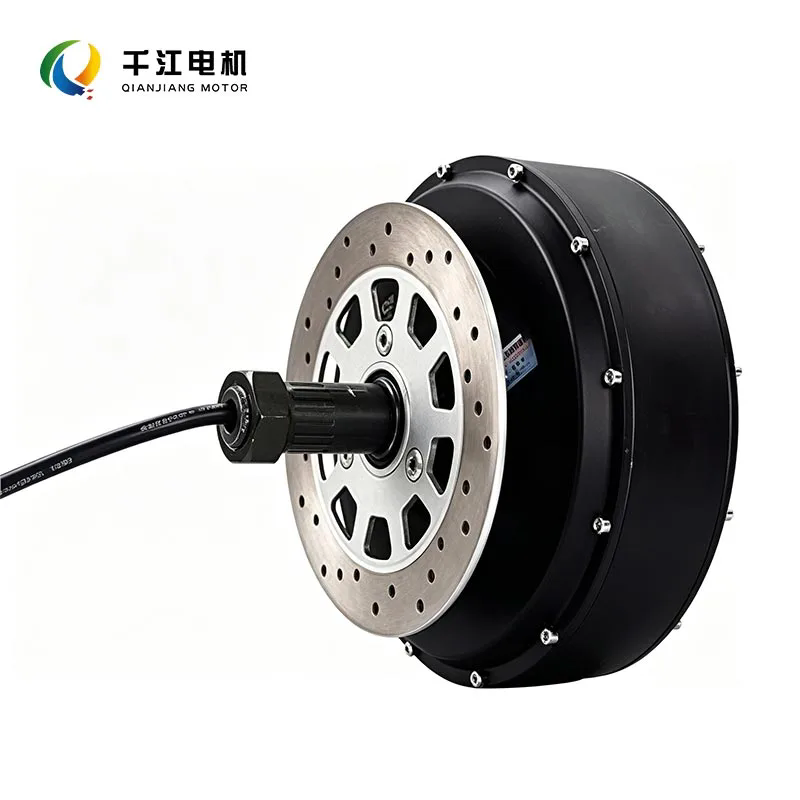
In our factory, we manufacture Hub Motors for electric two and three wheelers with integrated energy recovery capability. The motor controller is programmed to switch to generator mode when the throttle is released or the brake lever is pressed. Ningbo Qianjiang Motor Co., Ltd. has been manufacturing hub motors for over 12 years.
2. How Does Regenerative Braking Convert Motion Back Into Stored Energy?
The energy recovery process has three stages. In the first stage, the motor is switched from driving mode to generating mode. The permanent magnets in the rotor induce a voltage in the stator windings as the wheel turns. This voltage is called the back electromotive force. In the second stage, the controller rectifies the alternating current from the motor into direct current and boosts the voltage to match the battery voltage. In the third stage, the battery accepts the charging current, up to the limit set by the battery management system. The Hub Motors design is particularly suited to this process because the motor is directly coupled to the wheel. There is no chain, belt, or gearbox between the motor and the road, so the transmission losses are minimal. The table below shows the recovered power and energy at different speeds and deceleration rates.
| Speed | Deceleration | Recovered power | Recovered energy per event |
| 15 km/h | 0.5 m/s² | 180 W | 0.9 Wh |
| 25 km/h | 0.8 m/s² | 420 W | 2.3 Wh |
| 35 km/h | 1.0 m/s² | 680 W | 4.1 Wh |
| 45 km/h | 1.2 m/s² | 950 W | 6.8 Wh |
| 45 km/h | 2.0 m/s² | 1,580 W | 11.2 Wh |
In our factory, we test the recovery efficiency of every hub motor on a dynamometer. The test measures the electrical power returned to the battery at different speeds and deceleration rates. The recovery efficiency is typically 60 to 75 percent, depending on the speed and the controller settings. Ningbo Qianjiang Motor Co., Ltd. provides the recovery efficiency map with each motor model.
3. What Determines How Much Energy Can Actually Be Recovered in Real Driving?
The theoretical energy that can be recovered is limited by four factors. The first is the battery state of charge. If the battery is already at 95 percent or higher, the battery management system will limit or stop the charging current to prevent overcharging. The second is the battery temperature. At low temperatures, the battery cannot accept high charging current without risking lithium plating. The third is the controller strategy. The controller must balance the regenerative braking torque with the friction braking torque to maintain stability and avoid wheel lock. The fourth is the driver behavior. A driver who brakes gently and early recovers more energy than a driver who brakes hard and late. The table below shows the recovery efficiency and range contribution under different operating conditions.
| Operating condition | Recovery efficiency | Range contribution | Typical limitation |
| Flat city route, 25°C | 65 – 75% | 12 – 18% | None |
| Hilly route, 25°C | 55 – 65% | 18 – 25% | High deceleration events |
| City route, 0°C | 30 – 45% | 5 – 10% | Battery charging limit at low temperature |
| Battery at 95% SOC | 0 – 20% | 0 – 3% | BMS charging limit |
| Highway constant speed | Low | 2 – 5% | Few braking events |
Vehicle engineer's note: The range contribution from energy recovery is highest in stop-and-go city driving and hilly terrain. It is lowest in constant-speed highway driving and in cold weather. In our factory, we recommend that the vehicle designer program the controller to maximize recovery in the speed range where the vehicle operates most often. We also recommend that the battery management system be configured to allow charging up to 95 percent SOC so that there is headroom for recovery. Ningbo Qianjiang Motor Co., Ltd. provides application support for controller and BMS integration.
4. Why Do Hub Motors Require a Different Energy Recovery Strategy Than Central-Drive Vehicles?
A vehicle with Hub Motors has one motor per driven wheel. Each motor can be controlled independently. This allows the controller to adjust the recovery torque on each wheel based on the wheel speed and the slip ratio. In a central-drive vehicle, a single motor drives both wheels through a differential, so the recovery torque is the same on both sides. The independent control of hub motors provides three advantages. The first is better stability on split-friction surfaces, such as a wet road with one wheel on paint. The second is more precise traction control during recovery. The third is the ability to recover energy from each wheel separately during cornering. The table below compares the recovery characteristics of hub motors and central-drive systems.
| Characteristic | Hub Motors | Central drive |
| Number of motors | One per driven wheel | One for all driven wheels |
| Recovery control | Independent per wheel | Common for all wheels |
| Transmission losses | Low (direct drive) | Higher (gearbox, differential) |
| Response time | Fast (no mechanical lag) | Slower (mechanical lag) |
| Stability on split friction | Good (individual control) | Moderate (differential action) |
In our factory, we develop the recovery strategy for each hub motor model in cooperation with the vehicle manufacturer. The strategy defines the maximum recovery torque as a function of speed, the slip threshold for activation, and the blending ratio with the friction brake. Ningbo Qianjiang Motor Co., Ltd. validates the strategy on a test track with wet and dry surfaces.
5. How Should Vehicle Designers Specify and Verify an Energy Recovery System?
The specification of an energy recovery system for a hub motor vehicle must include four parameters. The first is the back electromotive force constant of the motor, which determines the voltage generated at a given speed. The second is the maximum charging current of the controller. The third is the maximum charging power that the battery can accept, as defined by the battery management system. The fourth is the blending strategy between the regenerative brake and the friction brake. The verification should include three tests. The first is a dynamometer test to measure the recovery efficiency at different speeds. The second is a coast-down test to measure the actual energy returned to the battery during deceleration. The third is a range comparison test with the recovery system enabled and disabled. In our factory, we perform these tests for every new vehicle platform and provide the test report to the customer.
We also recommend that the designer verify the recovery behavior at high SOC and low temperature, because these are the conditions where the recovery is most limited. A system that works well at 25°C and 50 percent SOC may provide almost no recovery at 0°C and 95 percent SOC. Ningbo Qianjiang Motor Co., Ltd. provides a recovery performance map that covers the full operating envelope of the vehicle.
Frequently Asked Questions About Energy Recovery in Hub Motor Vehicles
Summary for Vehicle Designers and Fleet Operators
Energy recovery extends the range of hub motor vehicles by converting the kinetic energy that would otherwise be dissipated in the friction brakes back into stored electrical energy. The recovery is most effective in stop-and-go city driving and hilly terrain, where the range gain can reach 12 to 25 percent. The recovery is limited by battery state of charge, battery temperature, controller strategy, and driver behavior. Hub motors require an independent per-wheel recovery strategy because each wheel can be controlled separately. The specification should include the motor back electromotive force constant, the controller charging current, the battery charging limit, and the brake blending strategy. Ningbo Qianjiang Motor Co., Ltd. has been manufacturing Hub Motors for over 12 years and provides full recovery strategy and verification support for vehicle designers.