

How Do Hub Motors Provide Faster Response in Urban Riding?
2026-10-14
A commuter rides an e-bike with a rear Hub Motors through city traffic. The light turns green. The rider presses the throttle. The bike accelerates immediately, pulling ahead of the cars before they have even moved. A second rider on a mid-drive e-bike does the same thing. The bike hesitates for a fraction of a second before the power reaches the wheel. The difference is not the motor power rating. It is the response time. In urban riding, where gaps in traffic open and close in less than a second, the response time of the motor determines whether the rider feels confident or vulnerable. This guide explains why hub motors respond faster and how that translates to real riding advantages.
1. What Is the Physical Path of Power in a Hub Motor vs. a Mid-Drive Motor?
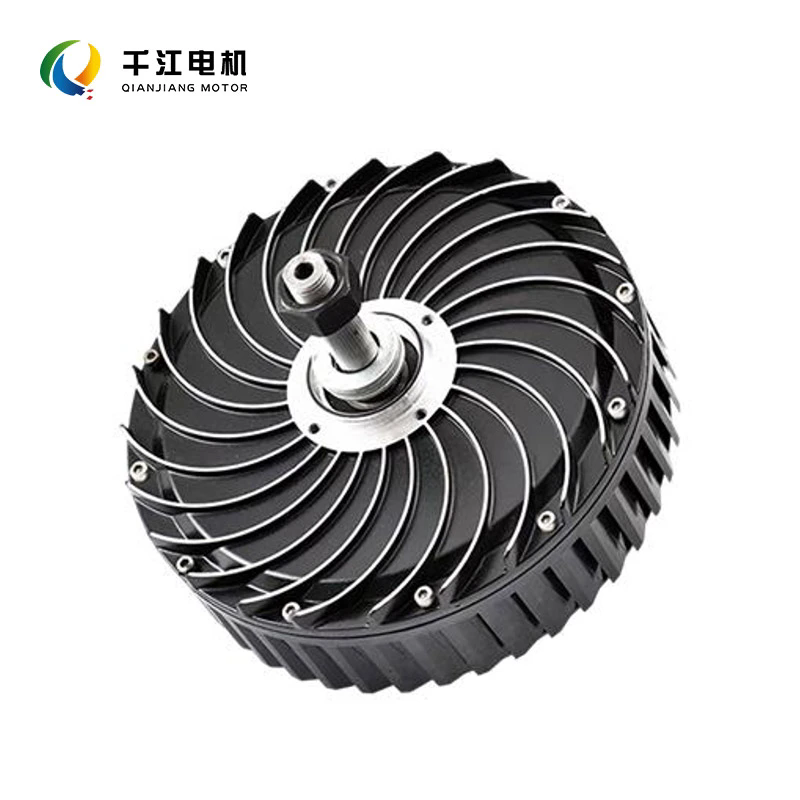
The response time of an electric bike is determined by the path the power takes from the motor to the wheel. In a Hub Motors, the motor is inside the wheel hub. The stator is mounted on the axle, and the rotor is connected directly to the wheel. When the motor produces torque, the wheel turns immediately. There is no chain, no belt, and no gearbox between the motor and the wheel. In a mid-drive motor, the motor is mounted at the bottom bracket. The power goes through the chain and the gears before it reaches the wheel. The chain has tension and elasticity. The gears have backlash. These factors add a delay of 50 to 150 milliseconds between the motor torque and the wheel torque. The table below compares the power path of the two systems.
| Parameter | Hub Motors (direct drive) | Mid-drive motor |
| Power transmission path | Motor → wheel (direct) | Motor → chain → gears → wheel |
| Components between motor and wheel | None | Chain, sprockets, derailleur |
| Mechanical backlash | None | 2 – 5 degrees at chain |
| Response delay | 10 – 30 ms | 50 – 150 ms |
| Maintenance points | None (sealed motor) | Chain, cassette, derailleur |
The direct path of a Hub Motors eliminates the mechanical delays that are inherent in a chain-drive system. This is why the response feels immediate. In our factory, we measure the step response of our hub motors by applying a step current to the controller and measuring the time for the wheel to reach 90 percent of the commanded torque. The response time is 15 to 25 milliseconds for our direct drive hub motors. Qianjiang Motor has been manufacturing hub motors for over 15 years.
2. How Does Controller Current Response Affect Acceleration?
The motor itself responds quickly, but the controller must also respond quickly. The controller converts the battery voltage into the current that the motor needs. The current rise time is determined by the controller's switching frequency and the inductance of the motor windings. A controller with a high switching frequency and a low-inductance motor can increase the current faster. The table below shows the relationship between controller specifications and current rise time.
| Controller switching frequency | Motor inductance | Current rise time (0 to 90%) | Perceived response |
| 10 kHz | 500 µH | 45 ms | Moderate |
| 20 kHz | 500 µH | 22 ms | Fast |
| 20 kHz | 300 µH | 14 ms | Very fast |
| 30 kHz | 300 µH | 9 ms | Immediate |
| 30 kHz | 200 µH | 6 ms | Immediate |
In our factory, we design our Hub Motors with low inductance windings and match them with controllers that have a switching frequency of 20 to 30 kHz. This combination provides a current rise time of less than 15 milliseconds. The result is a throttle response that feels instantaneous. Ningbo Qianjiang Motor Co., Ltd. provides controller and motor matching services to ensure that the system response meets the customer's requirements.
3. How Does Urban Riding Benefit From Faster Response?
Urban riding involves frequent starts and stops, lane changes, and avoidance of obstacles. Each of these maneuvers requires a rapid change in speed. The faster the motor responds, the more control the rider has. The table below shows the specific urban scenarios where hub motor response provides an advantage.
| Urban scenario | Response requirement | Hub motor advantage |
| Traffic light start | Immediate torque to accelerate from 0 km/h | Direct drive provides torque without chain hesitation |
| Lane change in traffic | Quick speed adjustment to match gap | Faster torque response allows precise speed control |
| Hill start | Torque before the bike rolls back | No chain slack; torque is applied instantly |
| Obstacle avoidance | Sudden acceleration or deceleration | Regenerative braking and acceleration respond faster |
| Low-speed maneuvering | Smooth torque at walking pace | Direct drive provides smooth torque without gear lash |
Rider feedback: In our factory, we have conducted ride tests with commuters who use both hub motor and mid-drive e-bikes. The riders consistently report that the hub motor feels more responsive in stop-and-go traffic. They also report that they feel more confident when merging into traffic because the bike accelerates immediately when they press the throttle. This confidence is a safety benefit, not just a comfort benefit.
4. What Are the Trade-Offs of Hub Motors in Urban Riding?
Hub Motors are not without limitations. The direct drive design does not benefit from the gear reduction that a mid-drive motor can use. This means that a hub motor produces less torque at very low speeds and is less efficient on steep hills. The table below shows the trade-offs between hub motors and mid-drive motors for urban riding.
| Parameter | Hub Motors | Mid-drive motor |
| Response time | 10 – 30 ms | 50 – 150 ms |
| Low-speed torque | Moderate | High (with gear reduction) |
| Hill climbing | Moderate | Excellent |
| Weight distribution | Rear-heavy (if rear hub) | Central |
| Maintenance | Low | Moderate (chain and gears) |
| Cost | Lower | Higher |
For flat urban environments, the hub motor is the better choice because of its faster response and lower maintenance. For hilly cities, a mid-drive motor may be preferred because of its higher low-speed torque. In our factory, we produce both types of motors and can advise on the best choice for the target market. Ningbo Qianjiang Motor Co., Ltd. has a full range of hub motors for different wheel sizes and power ratings.
Frequently Asked Questions About Hub Motor Response in Urban Riding
Summary for Product Managers and OEM Buyers
Hub Motors provide faster response in urban riding because the power path from the motor to the wheel is direct. There is no chain, no derailleur, and no gearbox to introduce delay. The response time of a hub motor is 10 to 30 milliseconds, compared to 50 to 150 milliseconds for a mid-drive motor. This faster response translates to better control in stop-and-go traffic, safer merging, and more confident hill starts. The trade-off is lower low-speed torque and less efficiency on steep hills. For flat urban environments, the hub motor is the better choice. Ningbo Qianjiang Motor Co., Ltd. has been manufacturing Hub Motors for over 15 years and provides full system matching and tuning support for our customers.
Ningbo Qianjiang Motor Co., Ltd. manufactures direct drive and geared Hub Motors in 350W, 500W, 750W, and 1000W ratings, with 36V, 48V, and 52V options. We provide controller matching, tuning software, and response time data for all of our products.