

How Are Hub Motors Used in Electric Bicycles and Scooters?
2026-10-21
A powertrain engineer at an e-scooter manufacturer reviews warranty claims for a shared fleet. The same Hub Motors model is used in two applications: a lightweight sharing scooter and a cargo three-wheeler. The sharing scooter has a 3-year failure rate of 2 percent. The cargo three-wheeler has a 6-month failure rate of 18 percent. The failures are demagnetization and bearing noise. The engineer investigates the duty cycle. The sharing scooter operates at an average load of 30 percent of the motor rating. The cargo three-wheeler operates at 85 percent of the rating on a daily route with steep ramps. The motor is thermally undersized for the cargo application. This guide explains how hub motors are matched to electric bicycles and scooters.
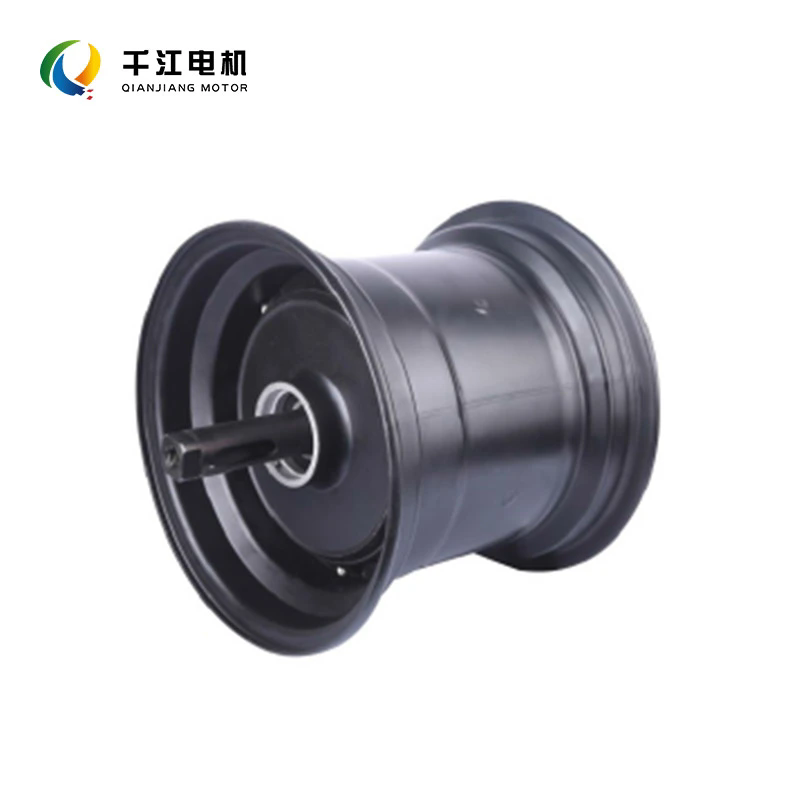
1. What Is the Torque-Speed Characteristic of a Hub Motors and How Does It Match the Vehicle?
A Hub Motors is a direct-drive or geared motor built into the wheel hub. The direct-drive motor has a single speed range and produces maximum torque at low speed. The geared motor uses an internal planetary gear to increase torque and reduce speed. The torque-speed curve determines the vehicle's acceleration and climbing ability. The table below shows the typical characteristics of direct-drive and geared hub motors for e-bikes and e-scooters.
| Motor type | Rated power | Max torque | Efficiency at low speed | Typical application |
| Direct-drive (e-bike) | 250 – 500 W | 30 – 50 Nm | Moderate (70 – 80%) | Commuting, flat terrain |
| Geared (e-bike) | 250 – 750 W | 50 – 80 Nm | High (80 – 85%) | Hilly terrain, cargo bikes |
| Direct-drive (e-scooter) | 500 – 1,500 W | 60 – 120 Nm | Moderate (75 – 85%) | Sharing fleets, urban commuting |
| Geared (e-scooter) | 350 – 1,000 W | 80 – 150 Nm | High (80 – 88%) | Delivery, cargo, steep ramps |
In our factory, we manufacture Hub Motors with both direct-drive and geared configurations. The choice depends on the vehicle weight, the terrain, and the duty cycle. For a cargo three-wheeler with a payload of 150 kg and a daily route with 10 percent grade ramps, we recommend a geared motor with a continuous torque rating of at least 60 Nm. Ningbo Qianjiang Motor Co., Ltd. has been manufacturing hub motors for over 12 years.
2. How Does Thermal Capacity Determine the Continuous Power Rating?
The continuous power rating of a Hub Motors is limited by the heat dissipation capability. The motor generates heat from copper losses (I²R) and iron losses. The heat must be conducted through the stator, the hub shell, and the spokes to the air. In a wheel hub, the surface area for heat dissipation is limited. The table below shows the thermal capacity and continuous power rating for different hub motor sizes.
| Motor diameter (mm) | Stator lamination length (mm) | Continuous power rating (W) | Peak power (30 s) (W) | Thermal resistance (°C/W) |
| 120 | 20 | 250 | 500 | 1.8 |
| 150 | 30 | 500 | 1,000 | 1.2 |
| 180 | 40 | 800 | 1,600 | 0.9 |
| 220 | 50 | 1,200 | 2,400 | 0.6 |
| 260 | 60 | 1,800 | 3,600 | 0.45 |
Powertrain engineer's note: The continuous power rating is the power the motor can deliver indefinitely without exceeding the thermal limit. The peak power rating is the power the motor can deliver for a short period (typically 30 seconds) before the thermal protection activates. For a cargo application, the motor must be selected based on the continuous power requirement, not the peak power. A motor that is rated for 500 W continuous and 1,000 W peak can deliver 500 W all day, but it can only deliver 1,000 W for 30 seconds. If the vehicle needs 700 W to climb a hill, the motor will overheat and eventually fail. In our factory, we provide the thermal test data for each Hub Motors model so that the vehicle manufacturer can match the motor to the duty cycle.
3. How Does the Installation Position Affect Water and Dust Protection?
A Hub Motors is mounted in the wheel, which is exposed to water, mud, and dust. The ingress protection (IP) rating determines the motor's resistance to these elements. The most common IP ratings for hub motors are IP54 (dust-protected and splash-resistant) and IP65 (dust-tight and water-jet resistant). The table below shows the IP rating and the corresponding environmental conditions.
| IP rating | Dust protection | Water protection | Typical application |
| IP54 | Dust-protected (limited ingress) | Splash-resistant | Urban e-bikes, dry climates |
| IP65 | Dust-tight | Water-jet resistant | E-scooters, wet climates |
| IP67 | Dust-tight | Immersion-resistant (1 m, 30 min) | Off-road, cargo, shared fleets |
In our factory, we manufacture Hub Motors with IP54, IP65, and IP67 ratings. The sealing is achieved through double-lip seals, O-rings, and a sealed cable entry. We test every motor design in a water spray chamber and a dust chamber. We also recommend that the vehicle manufacturer route the cable with a drip loop to prevent water from entering the motor through the cable. Ningbo Qianjiang Motor Co., Ltd. provides the IP test report for each motor model.
4. How Does the Controller Match the Hub Motors?
The controller is the electronic unit that regulates the power to the Hub Motors. The controller must be matched to the motor's voltage, current, and phase configuration. A mismatch can cause overheating, reduced efficiency, or controller failure. The table below shows the matching parameters for common hub motor and controller combinations.
| Motor voltage | Motor rated current | Controller continuous current | Controller peak current | Typical application |
| 36 V | 15 A | 15 A | 30 A | Light e-bike |
| 48 V | 20 A | 20 A | 40 A | Commuting e-bike |
| 48 V | 25 A | 25 A | 50 A | E-scooter |
| 60 V | 30 A | 30 A | 60 A | Cargo three-wheeler |
| 72 V | 40 A | 40 A | 80 A | High-performance e-scooter |
In our factory, we test the motor and controller as a system. We verify the phase current, the hall sensor signals, and the thermal protection response. We also provide the controller parameter settings for each motor model. Ningbo Qianjiang Motor Co., Ltd. offers a matched motor and controller package for vehicle manufacturers who want a validated system.
Frequently Asked Questions About Hub Motors in Electric Bicycles and Scooters
Summary for Powertrain Engineers and Vehicle Manufacturers
Hub Motors are used in electric bicycles and scooters because they are compact, efficient, and easy to integrate into the wheel. The selection of a hub motor depends on the torque-speed characteristic, the thermal capacity, the IP rating, and the controller match. The torque-speed curve determines the acceleration and climbing ability. The thermal capacity determines the continuous power rating. The IP rating determines the resistance to water and dust. The controller must be matched to the motor to ensure reliable operation. By understanding these factors, powertrain engineers can select the right hub motor for each vehicle platform. Ningbo Qianjiang Motor Co., Ltd. has been manufacturing Hub Motors for over 12 years and provides full engineering support for our customers.
Ningbo Qianjiang Motor Co., Ltd. manufactures Hub Motors for e-bikes and e-scooters in direct-drive and geared configurations, with IP54, IP65, and IP67 ratings. We provide thermal test data, IP test reports, and controller matching support for all of our products.