

Does a 200W Servo Motor Need a Brake for Vertical Applications
2026-07-08
When designing a vertical axis—such as a Z‑axis lift, a robotic arm, or a CNC gantry—one of the most critical decisions is whether your 200W servo motor requires an integrated holding brake. The answer is not a simple yes or no; it depends on load characteristics, duty cycle, and safety requirements. In this guide, we break down the engineering logic, compare braked vs. non‑braked configurations, and share real‑world best practices from Hongyunteng’s application engineering team.
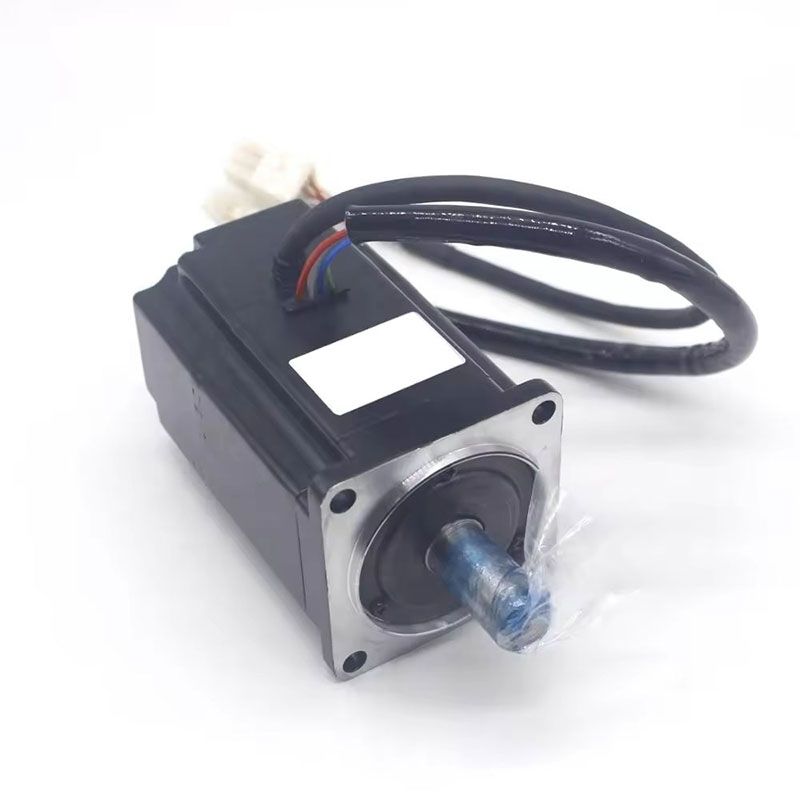
The Core Question: What Does a Brake Actually Do?
A brake in a 200W servo motor is a spring‑engaged, electrically released holding device. It activates when power is cut off, preventing the motor shaft from rotating. In vertical applications, the brake resists gravitational torque. Without it, an unpowered motor could back‑drive, causing the load to drop.
However, a brake is not a deceleration device—it is a holding device. Dynamic stopping is handled by the servo drive’s regenerative circuit and internal resistance.
When Is a Brake Mandatory?
| Application Condition | Brake Required? | Reason |
|---|---|---|
| Vertical lift with load > 50% of motor rated torque | Yes | Gravity exceeds holding capacity of the motor’s detent torque. |
| Intermittent operation with frequent power‑off stops | Yes | Safety requirement (e.g., emergency stop, power loss). |
| Continuous rotation (e.g., conveyor) | No | No static holding needed. |
| Light load (<30% rated torque) with external counterweight | Optional | Counterweight reduces gravitational force. |
| High‑precision positioning with external linear guide | Yes | Prevents micro‑drift during tool changes or idle periods. |
Hongyunteng recommends: for any vertical axis where the load can move more than 5 mm during a power failure, install a brake. The cost of a brake is far lower than the cost of a damaged workpiece or operator injury.
Mechanical Calculation – Do You Need One?
Use this simplified check:
-
Calculate gravitational torque – ��=�×�×� (mass × gravity × pulley radius).
-
Compare with motor holding torque – A typical 200W servo motor has a rated torque of ~0.64 N·m and a holding torque (detent) of ~0.07–0.10 N·m. The brake adds ~0.6–1.0 N·m holding capacity.
-
Safety factor – Apply a 2× safety margin. If ��×2> brake holding torque, you need a larger brake or a different mechanical design.
| Load Mass (kg) | Pulley Radius (mm) | Gravity Torque (N·m) | Brake Needed? |
|---|---|---|---|
| 2 | 20 | 0.39 | No (detent holds) |
| 5 | 20 | 0.98 | Yes (exceeds 0.64 N·m) |
| 8 | 15 | 1.18 | Yes (must use brake) |
Pros and Cons of Adding a Brake
| Aspect | Without Brake | With Brake |
|---|---|---|
| Cost | Lower (save ~15‑20%) | Higher (brake adds $30‑$50) |
| Motor length | Standard | Longer by ~25‑35 mm |
| Wiring | 2 power + 2 feedback | Additional 2 wires for brake control |
| Response time | Instant | Brake engage/disengage ~20‑50 ms delay |
| Maintenance | None | Brake air gap wears over time (check every 10k cycles) |
| Safety | Relies on drive holding current | Failsafe mechanical lock |
Hongyunteng offers both variants in our 200W servo motor series—with and without brake—so you can choose exactly what your vertical axis demands.
3 Practical FAQs About the 200W Servo Motor Brake
Q1: Can I use the servo drive’s dynamic braking instead of a mechanical brake for vertical loads?
A1: No. Dynamic braking dissipates kinetic energy during deceleration but does not hold a static load. When the servo drive is powered off, the dynamic brake circuit opens, and the motor shaft is free to rotate. For vertical applications, you must have a mechanical holding brake to lock the shaft during power‑off conditions. If you rely only on dynamic braking, the load will fall immediately after power loss. Some drives offer a “standstill current” function, but this consumes energy and generates heat—it is not a safety‑rated solution. Always use a dedicated brake for vertical safety.
Q2: How do I wire and control the brake on a 200W servo motor?
A2: The brake is normally closed (spring‑set). It requires a 24 V DC supply to release. In a typical setup, the servo drive provides a dedicated brake output signal. During operation, the drive applies 24 V to open the brake before motion starts (typically 50‑100 ms lead time). When motion stops and the drive disables the current, it removes the 24 V, and the brake engages within 20‑30 ms. You must sequence this correctly: never move the motor while the brake is engaged, and never disengage the brake while the motor is holding a vertical load without drive torque active. Hongyunteng provides wiring diagrams and PLC logic examples for all our 200W servo motor packages.
Q3: Does the brake affect the motor’s rated torque or speed performance?
A3: No—the brake is mechanically independent of the rotor and stator. It does not interfere with the electromagnetic torque generation. However, the brake does add inertia (typically 5‑10% of rotor inertia) and increases the overall motor length. This extra inertia may slightly affect acceleration/deceleration times in very high‑dynamic applications. For most vertical lifts, this is negligible. The brake also generates a small amount of heat when engaged (holding current ~0.3‑0.5 A at 24 V), so you should account for that in your thermal budget. In continuous holding applications, consider using a brake with a lower holding current or a bi‑stable design to reduce heat.
Real‑World Recommendation from Hongyunteng
Based on over 12,000 vertical installations, we observe that over 80% of field failures in non‑braked vertical axes are due to power glitches or emergency stops. The extra $40‑60 for a brake is the most cost‑effective insurance you can buy. For axes with light loads (<2 kg) and slow speeds, you may skip it—but always run the torque calculation.
We also advise using a brake with a manual release lever (optional on our 200W servo motor models) for maintenance and manual jogging during setup.
Summary Checklist – Vertical Application with a 200W Servo Motor
-
Calculated gravity torque with 2× safety factor
-
Compared with detent torque and brake holding torque
-
Decided brake vs. no‑brake based on duty cycle and safety class
-
Selected brake voltage (24 V DC standard) and wiring plan
-
Programmed drive brake timing (release before motion, engage after stop)
-
Included emergency stop logic that instantly engages brake
Ready to Specify Your 200W Servo Motor?
Choosing the right braking solution is easier with expert support. At Hongyunteng, we provide:
-
Free load‑calculation worksheets
-
3D CAD models with brake dimensions
-
Sample test units for vertical axis validation
-
24/7 technical support for wiring and tuning
Contact us today—email our motion engineers or visit our website to request a custom quote. Tell us your load, speed, and duty cycle, and we will recommend the exact 200W servo motor with or without a brake, shipped within 48 hours. Your vertical application deserves a safe, reliable partner—let Hongyunteng be that partner.