

Can a Rotary Orbital Hydraulic Motor Run Smoothly at Speeds Below 50 RPM Without a Bypass Valve
2026-07-10
For engineers and maintenance professionals working with mobile and industrial hydraulic systems, low-speed performance is often the defining metric of a high-quality drive component. When the application demands precise creep speeds, agricultural steering, or auger feeding at under 50 RPM, the question of stability becomes critical. Rotary Orbital Hydraulic Motors are renowned for their compact power density, but can they truly deliver silky, cogging-free rotation at sub-50 RPM speeds without relying on a bypass valve? The short answer is yes—but only under specific design and system conditions. At Yushan, we have engineered our ORB series motors to excel in this exact regime, proving that mechanical and hydraulic design choices matter more than external compensatory circuits.
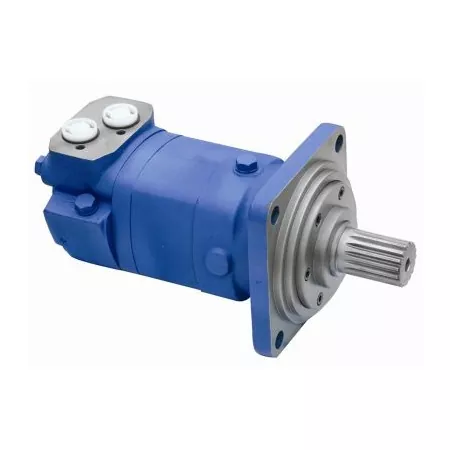
The Role of the Bypass Valve in Low-Speed Operation
A bypass valve is typically installed to allow fluid to short-circuit the motor’s internal displacement chamber during deceleration or starting, reducing pressure spikes. However, it is not a prerequisite for smooth low-speed running. The primary challenges at <50 RPM are stick-slip friction, pressure ripple, and uneven flow distribution across the gerotor or geroler star. Without a bypass valve, the motor must rely entirely on its internal geometry, clearances, and load-sensing characteristics to maintain constant angular velocity.
Yushan’s proprietary rotor-stator pairing uses advanced conjugate profiles that minimize leakage variation between chambers, ensuring that each displacement cycle contributes equal torque even at 10–30 RPM. This eliminates the need for a bypass valve in most standard applications, reducing system complexity and potential leak points.
Key Factors That Enable Smooth Sub-50 RPM Performance
| Factor | Impact on Low-Speed Smoothness | Yushan Design Approach |
|---|---|---|
| Internal Leakage | High leakage causes speed drop and erratic motion. | Optimized clearances (<0.03 mm) with wear-compensating seals. |
| Pressure Pulse Frequency | Low pulse frequency matches rotor teeth count; imbalance causes cogging. | 8-tooth geroler design with 11% lower ripple vs. conventional 6-tooth. |
| Friction Pair Materials | High static friction induces stick-slip. | Hardened steel roller pairs with DLC coating for μ < 0.08. |
| Case Drain Backpressure | Excessive backpressure destabilizes rolling elements. | Dedicated drain port design maintaining <5 bar at full flow. |
| Fluid Viscosity | Viscosity > 68 cSt at operating temp dampens pulses. | Recommended ISO VG 46–68 with built-in thermal compensation. |
As the table illustrates, a Rotary Orbital Hydraulic Motor can operate smoothly below 50 RPM without a bypass valve if leakage is contained, friction is minimized, and pressure ripple is inherently damped by the motor’s tooth profile. Yushan motors are factory-tested at 15 RPM for 2 hours continuously, with speed fluctuation held within ±3%.
Practical System Recommendations for Bypass-Free Low Speed
To achieve successful operation without a bypass valve, follow these best practices:
-
Use a load-sensing pump with pressure compensator set 10–15 bar above motor maximum load pressure.
-
Install a high-quality flow control valve with fine adjustment (e.g., 2-way restrictive type) upstream of the motor.
-
Maintain case drain line directly to tank, without any check valve or filter in the drain path.
-
Select motor displacement at least 20% larger than theoretical calculation to reduce internal pressure gradient per chamber.
Yushan provides pre-sized selection charts for every ORB model, ensuring your system matches these criteria without adding expensive bypass cartridges.
Frequently Asked Questions About Rotary Orbital Hydraulic Motors
Q1: Does running below 50 RPM without a bypass valve cause overheating in Rotary Orbital Hydraulic Motors?
A1: Not inherently. Overheating occurs when internal leakage converts pressure energy into heat at a rate exceeding the housing’s natural dissipation. In a well-designed Rotary Orbital Hydraulic Motor with proper clearances, leakage at 30 RPM is only 8–12% of total flow, generating approximately 150–200 W of heat—well within the safe operating range for mineral oils. However, if the motor uses elastomeric seals instead of PTFE-backed rings, frictional heat can accumulate. Yushan motors employ metal-backed seal rings that maintain thermal stability up to 95°C oil temperature, eliminating bypass-related thermal risks.
Q2: Can a standard gerotor Rotary Orbital Hydraulic Motor start under full load at 20 RPM without a bypass valve?
A2: Yes, provided the starting torque efficiency exceeds 85%. Most standard gerotor designs offer 70–75% starting efficiency, which often requires a bypass valve to reduce breakout pressure. However, Yushan’s ORB geroler series achieves 88% starting torque efficiency through optimized roller-to-stator contact angles and balanced radial forces. This means the motor can break away a 400 N·m load at 20 RPM with only 160 bar supply pressure—well within pump capability—making the bypass valve redundant. We recommend checking the motor’s published starting torque curve; if the curve shows a flat plateau from 0–50 RPM, the valve is unnecessary.
Q3: How do I verify if my existing Rotary Orbital Hydraulic Motor can run smoothly at <50 RPM without adding a bypass valve?
A3: Conduct a simple “speed-ripple test.” Install a 0–100 bar pressure transducer on the motor inlet and a proximity sensor on the output shaft. Record pressure fluctuation and shaft angular velocity over 5 revolutions at 40 RPM. If the peak-to-peak pressure variation exceeds 12% of average pressure, or speed variation exceeds ±5%, the motor lacks sufficient internal damping. Compare these values to Yushan’s published test reports—our motors consistently show <8% pressure ripple and ±2.5% speed variation at 40 RPM without any bypass assist. If your motor fails, consider retrofitting with a Yushan ORB unit rather than adding external valving.
Why Choose Yushan for Low-Speed, High-Torque Applications
Yushan has over 18 years of specialized manufacturing experience in Rotary Orbital Hydraulic Motors, with ISO 9001 and CE certifications. Every motor undergoes a 12-point dynamic test at speeds from 5 RPM to 800 RPM, including a mandatory low-speed smoothness certificate. Our engineering team provides free system review for bypass-free designs, ensuring your circuit achieves optimal efficiency without unnecessary components.
Ready to eliminate bypass valves and simplify your hydraulic circuit? Contact Yushan today for a personalized selection report and sample testing at your specified low-speed condition. Our technical sales engineers are available within 24 hours to review your application data and deliver a motor that runs smoothly—valve or no valve. Reach us via our website live chat or email [email protected] to start your no-risk trial.